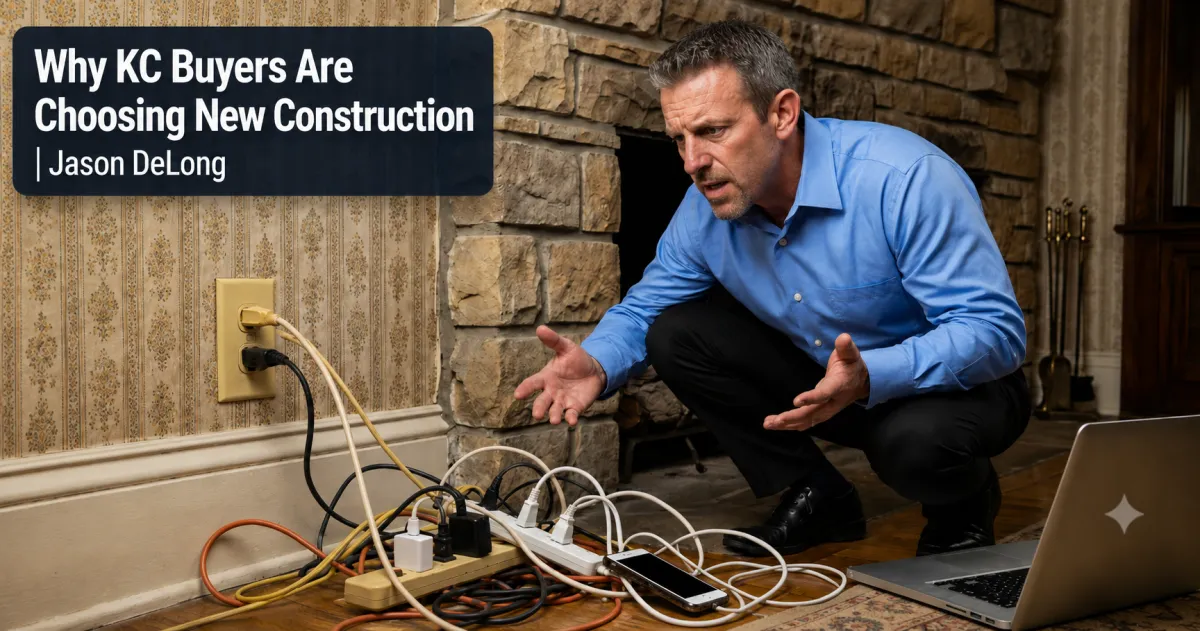
Why KC Buyers Are Choosing New Construction | Jason DeLong
THE "1970S OUTLETS EPIPHANY": WHY KANSAS CITY BUYERS ARE QUIETLY CHOOSING NEW CONSTRUCTION
You know exactly what I'm talking about.
You spend a Saturday morning touring a charming older home in Midtown or Waldo. Original crown molding. Wavy glass windows. A front porch that whispers "sit here with coffee." You start mentally placing furniture before you've even seen the master bedroom.
Then you glance down at the baseboard. One outlet. Two-prong. Yellowed with age. Located in the single most inconvenient corner of the room.
That's what I call the 1970s Outlets Epiphany, the exact moment the romantic vision of owning a historic Kansas City home collides with the reality of actually living in one in 2026.
I've built over 100 homes and flipped over 150 homes personally, so I know a thing or two about the process. And I'll tell you: the outlet problem isn't the problem. It's a symptom. It's the visible edge of a much deeper infrastructure gap that almost nobody talks about when they're swooning over hardwood floors.
THE EXTENSION CORD TETRIS PROBLEM
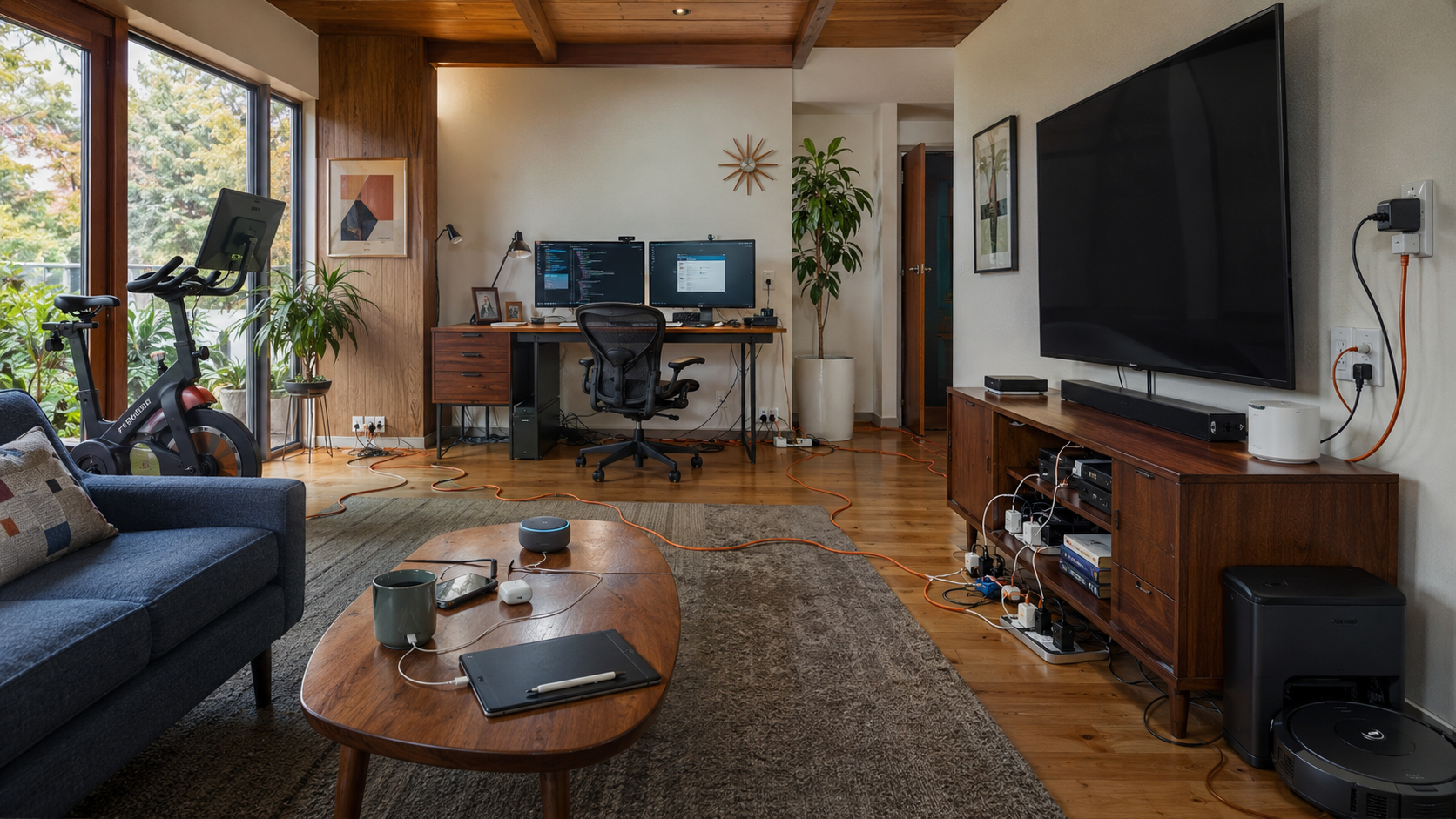
The people who built those gorgeous mid-century homes weren't designing for a household with dual-monitor remote work setups, Peloton bikes, six active phone chargers, a smart speaker in every room, a robot vacuum on a schedule, and a 4K streaming system pulling serious bandwidth on three TVs simultaneously. They were designing for a floor lamp and maybe a clock radio.
So what do you do when you move in? You become a master of Extension Cord Tetris. You run orange cords under area rugs. You daisy-chain power strips behind the console and pray the breaker holds when you run the microwave and the hair dryer at the same time. It's an aesthetic nightmare and a genuine daily stressor.
And the outlets are just one piece. Run through the real list of what modern life demands from a home:
Wi-Fi dead zones are common in older homes because plaster walls absorb wireless signal. You end up buying three different mesh extenders just to get coverage from the kitchen to the bedroom. Electrical panels in mid-century homes are often 100-amp services. Modern households regularly need 200 amps or more. HVAC systems, water heaters, and insulation in older construction weren't designed for today's energy costs. And if the home has original knob-and-tube or aluminum wiring, you're looking at a significant safety and insurance conversation before you even move your couch in.
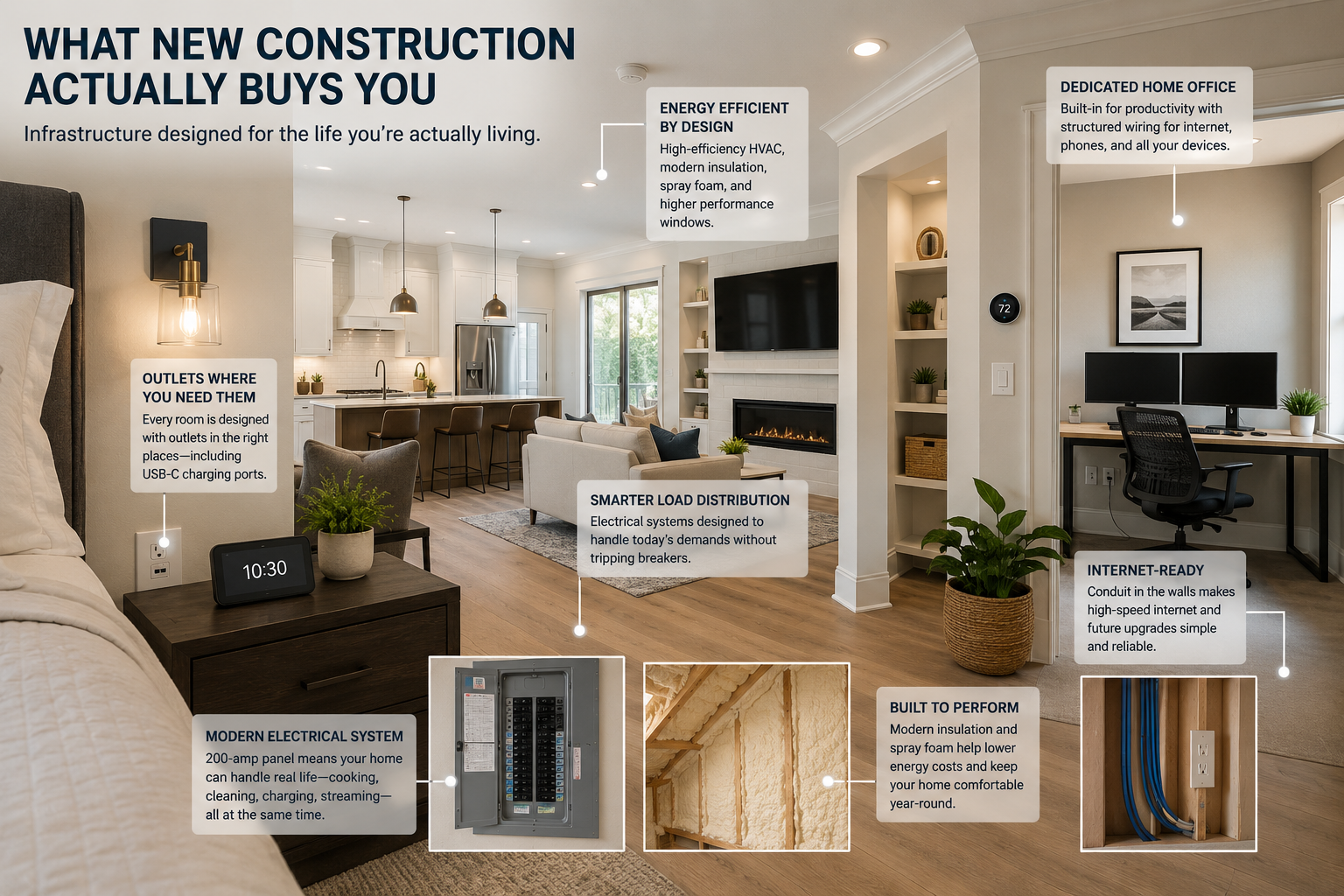
WHAT NEW CONSTRUCTION ACTUALLY BUYS YOU
Here's something I tell buyers who are torn between a charming older home and a new build: the price difference on paper is rarely the real comparison. The real comparison is the total cost of ownership over the first five years.
New construction gives you infrastructure designed for the life you're actually living. Outlets where your nightstands go, with built-in USB-C charging ports. Dedicated home office spaces with structured wiring runs. 200-amp panels. Energy-efficient HVAC. Modern insulation. Spray foam. Internet-ready conduit in the walls. An electrical load distribution that doesn't panic when you cook dinner and run the dishwasher at the same time.
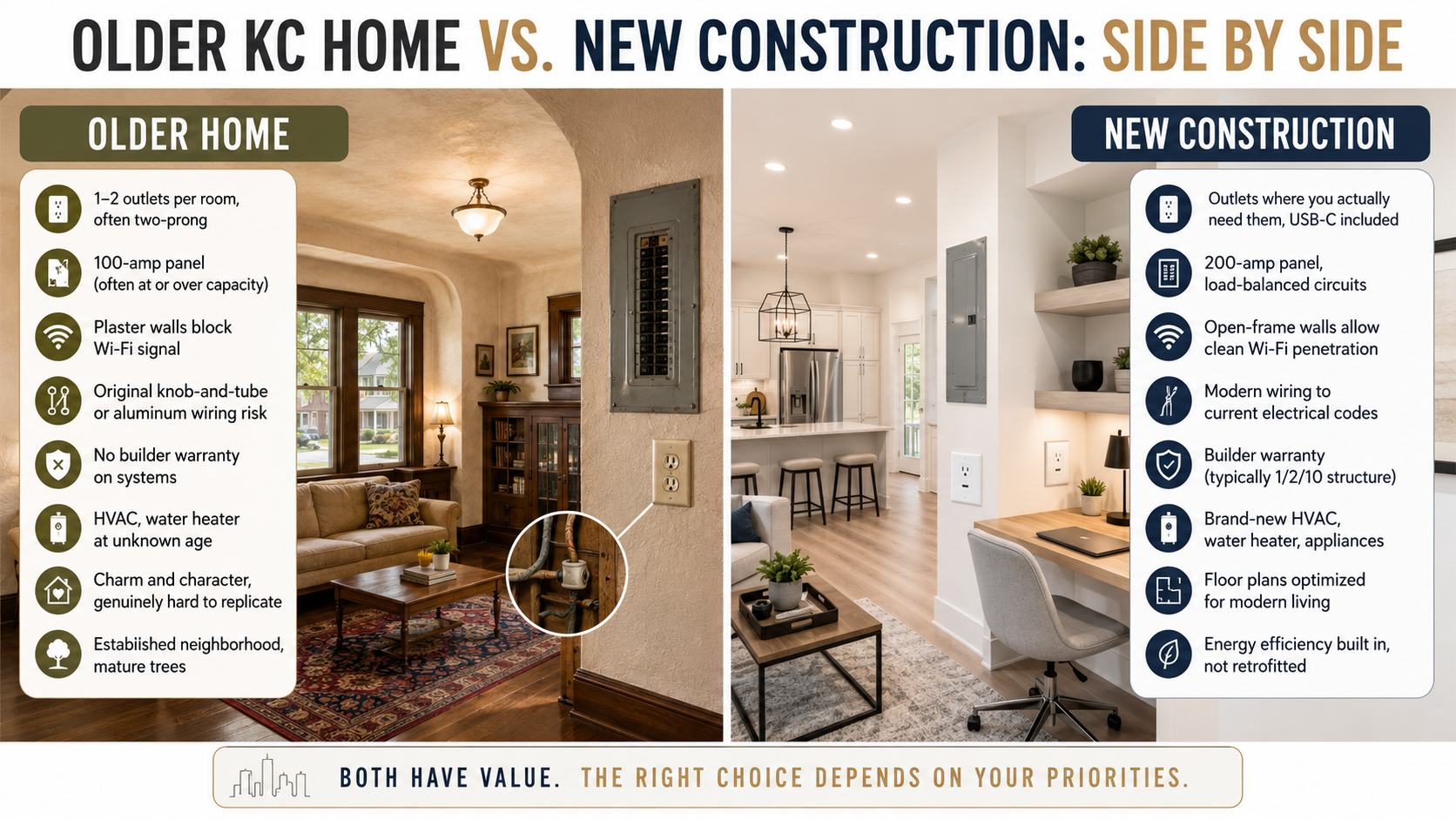
OLDER KC HOME VS. NEW CONSTRUCTION: SIDE BY SIDE
Older Home:
- 1-2 outlets per room, often two-prong
- 100-amp panel (often at or over capacity)
- Plaster walls block Wi-Fi signal
- Original knob-and-tube or aluminum wiring risk
- No builder warranty on systems
- HVAC, water heater at unknown age
- Charm and character, genuinely hard to replicate
- Established neighborhood, mature trees
New Construction:
- Outlets where you actually need them, USB-C included
- 200-amp panel, load-balanced circuits
- Open-frame walls allow clean Wi-Fi penetration
- Modern wiring to current electrical codes
- Builder warranty (typically 1/2/10 structure)
- Brand-new HVAC, water heater, appliances
- Floor plans optimized for modern living
- Energy efficiency built in, not retrofitted
THE REAL COST MATH ON OLDER HOMES
When buyers fall in love with a $275,000 Brookside or Waldo home and get sticker shock at a $350,000 new build in the Northland or Liberty, the $75,000 gap feels decisive. But here's what that older home often needs in the first five years:
Electrical panel upgrade (100A to 200A): $3,500-$7,000
Adding outlets and rewiring select rooms: $4,000-$12,000
HVAC replacement (if aging at purchase): $8,000-$16,000
Roof replacement (depending on age): $10,000-$22,000
Plumbing updates (galvanized pipe): $3,000-$15,000
Insulation and air sealing (energy leaks): $3,000-$8,000
Potential total: $31,500-$80,000
Not every older home needs all of that. Some have been beautifully maintained and selectively updated. But the buyers who come to me after two years in a mid-century home often describe a slow-drip of unexpected costs that quietly eroded the deal they thought they got. The math deserves a real look, not a romanticized skip.

SO SHOULD YOU BUY NEW CONSTRUCTION IN KANSAS CITY?
Not automatically. The charm of a historic home in Waldo, Brookside, Valentine, or the Crossroads area is real, and for the right buyer, it's worth every dollar and every extension cord. I have clients who would never trade their original craftsman bungalow for any new build on earth, and that's a completely legitimate position.
But the decision should be made with clear eyes, not rose-colored ones. Before you fall in love with a historic home, do the infrastructure audit alongside the emotional one. Get an electrical inspection. Find out the age of the HVAC and water heater. Ask about the panel. Pull permits to see what's been updated and what hasn't.
And if you're a remote worker, a family with serious tech demands, or someone who genuinely values a low-maintenance lifestyle, new construction in the Kansas City Metro, from the Northland communities to Lee's Summit, Olathe, and Lenexa, deserves a serious look.
A blank slate isn't just about aesthetics. It's about infrastructure that fits your life, not infrastructure you have to retrofit your life around.
FREQUENTLY ASKED QUESTIONS
Q: What are the biggest hidden problems with buying an older home in Kansas City?
A: Beyond cosmetic charm, older Kansas City homes commonly have outdated electrical panels, two-prong ungrounded outlets, knob-and-tube or aluminum wiring, plaster walls that block Wi-Fi signals, and insufficient circuits for modern appliance loads. These aren't deal-breakers, but they are costs that should be factored into your offer and your five-year ownership budget.
Q: Is new construction actually more expensive than buying an older home in Kansas City?
A: The purchase price is typically higher, but the total cost of ownership over five years often narrows the gap considerably. When you account for deferred maintenance, system replacements, electrical and plumbing upgrades, and energy inefficiency in older homes, new construction's higher sticker price can represent real value, especially when backed by a builder warranty.
Q: Why are Kansas City buyers shifting toward new construction right now?
A: Modern life demands more from a home than mid-century infrastructure was designed to provide. Remote work, smart home tech, EV charging, high-speed internet, and energy efficiency are all pushing buyers to weigh infrastructure, not just aesthetics, when making their decision.
Q: Can I add more outlets and upgrade the electrical in an older KC home?
A: Yes, but it's not cheap or simple. Running new circuits through finished walls, upgrading from a 100-amp to 200-amp service, and replacing two-prong outlets with properly grounded modern ones can cost $8,000-$25,000 or more depending on scope.
Q: What should I look for when buying new construction in Kansas City?
A: Builder reputation, warranty coverage (look for 1-year workmanship, 2-year systems, 10-year structural), lot location, and whether the floor plan fits your actual lifestyle. Working with a buyer's agent who also understands construction gives you a significant advantage in negotiating upgrades and catching potential issues before closing.
---
Jason DeLong | Heartland Homes KC | eXp Realty
Licensed in Missouri & Kansas


