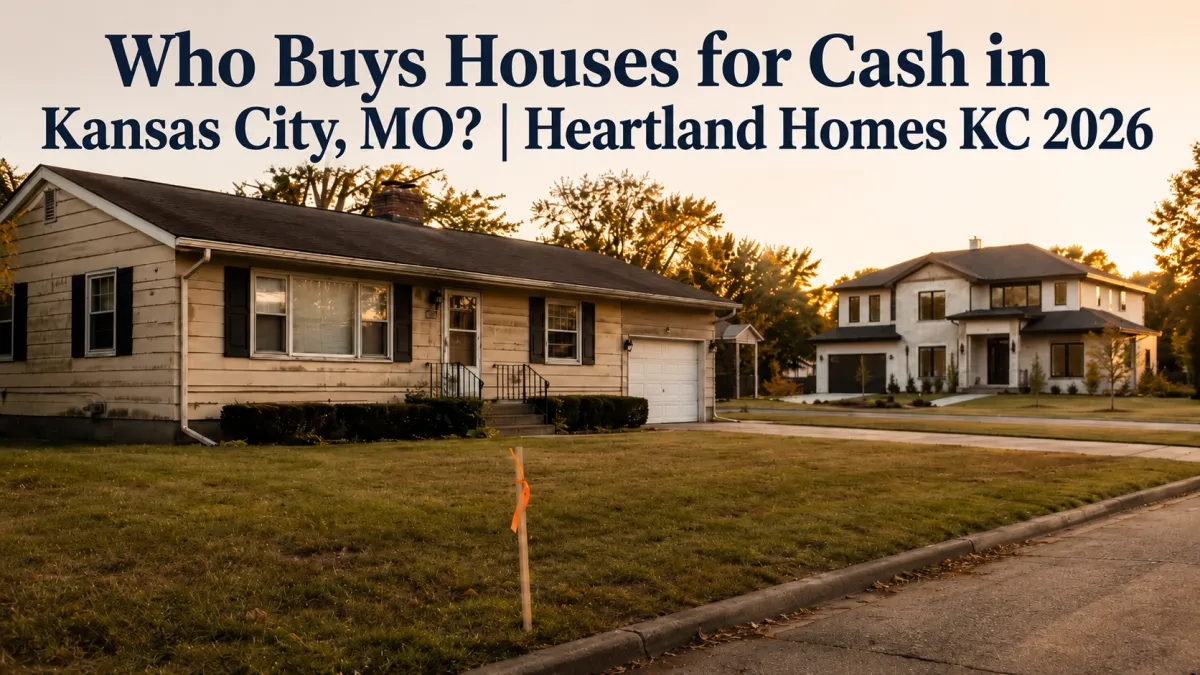
Who Buys Houses for Cash in Kansas City, MO? | Heartland Homes KC 2026
Who Buys Houses for Cash in Kansas City Without Repairs?
Most sellers asking this question expect a list of investor types and a link to a form. That is not what you are going to get here.
I have personally built over 100 homes in the Kansas City metro, flipped over 150 properties, and developed more than 25 subdivisions. That means I have been on the buying side of these exact transactions more times than I can count. I know what cash buyers see when they walk through your house. I know the formula they run in their head before they ever put a number on paper. And I know when a cash offer is fair and when it is not, because I have written both kinds.
The short answer to who buys houses for cash in Kansas City is developers, residential infill builders, fix-and-flip investors, and iBuyer platforms. But the answer that actually matters to you is which type values your specific property the most and why. Getting that distinction wrong is how sellers leave five figures, sometimes six, on the table without realizing it until the deal is already closed.
If you want to find out where your property sits in that range right now, start at guaranteedsoldkc.com/schedule-call and we will run the full analysis together. No pressure, no pitch. Just numbers.

The Four Types of Cash Buyers in Kansas City and What Each One Is Actually Paying
Not every cash buyer is looking at your property the same way. These four categories operate on completely different formulas, timelines, and motivations. Understanding the difference before you take a call from any of them is one of the most valuable things you can do.
New construction developers and infill builders are the category most sellers never think about, and they are often the highest-paying buyers for the right property. They are not buying your house. They are buying your lot. A developer looking to build a $500,000 home in an established Kansas City neighborhood does not care whether your kitchen was last updated in 1987 or whether the HVAC needs a full replacement. What they care about is lot dimensions, orientation, zoning, setbacks, and whether their finished product will support the price their model requires to work.
Fix-and-flip investors are the category most people picture when they hear "cash buyer." These are local operators, often individuals or small teams, who purchase distressed properties, renovate them, and resell at market value. They are more condition-sensitive than developers because the existing structure stays standing and becomes the product they sell. The formula they use is typically 70 percent of after-repair value minus estimated renovation costs. That math creates a hard ceiling, and properties that sit above a certain price point or below a certain condition threshold stop working for their model entirely.
iBuyer platforms and institutional programs are built for speed and standardization, not precision. The offer you receive from one of these platforms reflects a model designed for average properties in average conditions. If your property has something working specifically in its favor, an oversized lot, a location premium, or a site that appeals to a developer, the algorithm that priced your offer missed it. Convenience has a cost, and with iBuyer platforms, that cost is usually priced into the offer itself.
Wholesale buyers are the fourth category, and the one sellers understand the least. A wholesaler is not the end buyer. They are a middleman who contracts on your property at a significant discount and assigns that contract to a cash end-buyer for a fee. The discount required to make this transaction profitable for two parties instead of one is substantial. If a wholesaler is the first call you take, there is a strong chance you are working with the buyer type that captures the most margin from your sale.
The Part Most Sellers Get Wrong About Cash Sales
Here is the assumption that costs Kansas City sellers the most money: that an as-is cash sale means accepting a low number because the house is in rough shape.
That assumption is wrong for a specific category of property, and that category is larger than most sellers realize.
If your home sits on a lot in a neighborhood where new construction is trading above $400,000, the condition of the existing structure may be almost entirely irrelevant to the most motivated buyer in the market. A developer underwriting a teardown is not discounting your property because the roof is at the end of its life. They are building a model that starts with finished product value and works backward to what they can pay for the land to make the numbers work. The house is a demolition line item in their spreadsheet. It is not a price anchor.
This flips the traditional as-is narrative on its head. In these scenarios, the seller with the most deferred maintenance in the right neighborhood is not at a disadvantage. They are potentially sitting on a lot that commands developer-level acquisition pricing, which in active Kansas City submarkets can run well above what a renovated retail listing would net after months of carrying costs and renovation risk.
The baseline question before you talk to any buyer is what your property is actually worth in its current state relative to what the market supports around it. You can start building that picture at guaranteedsoldkc.com/home-value before you sit down with anyone making you an offer.
A Case Study From My Own Files: What the Right Buyer Type Actually Changes
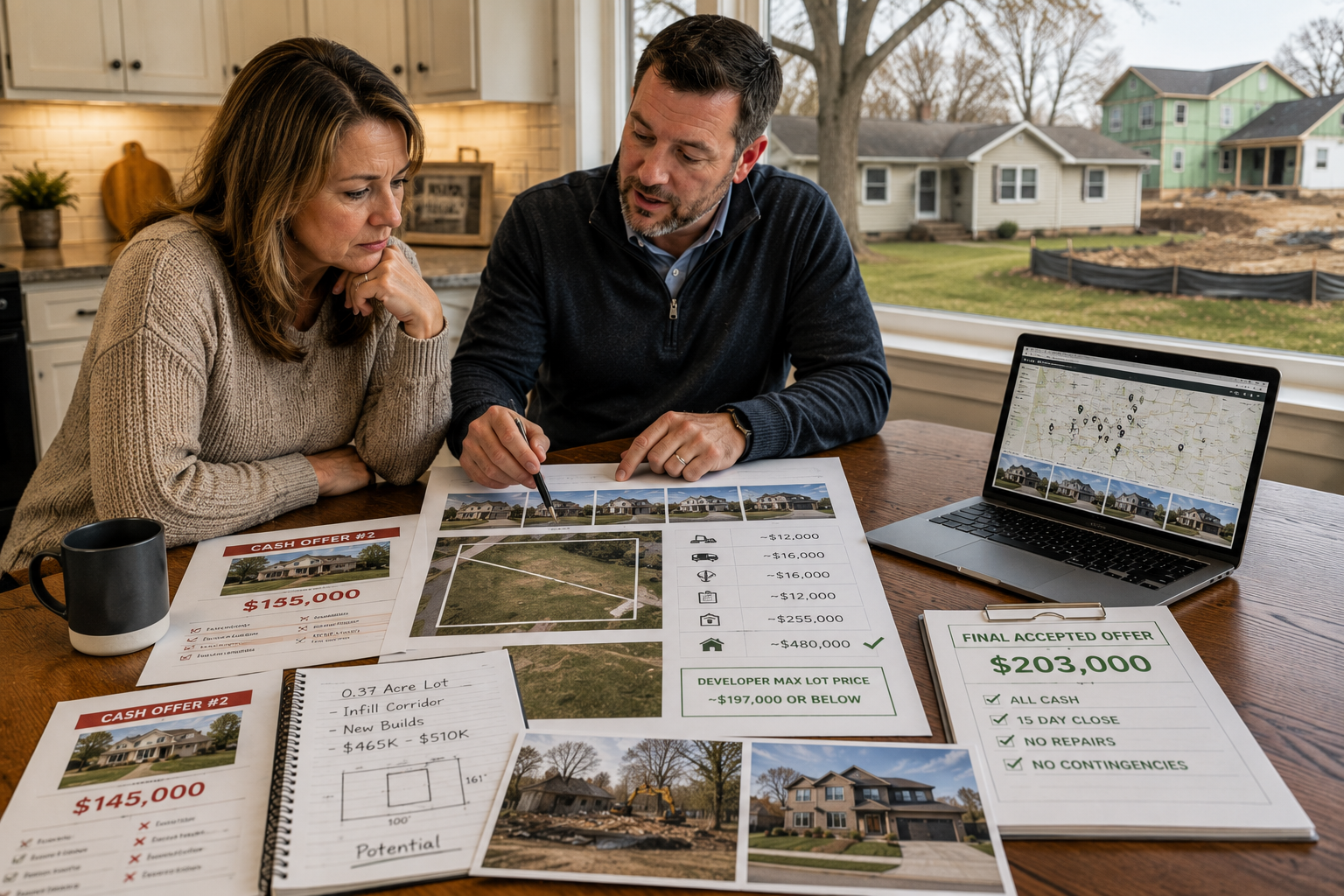
A seller in the Northland reached out to me after receiving two unsolicited cash offers. The first came in at $145,000. The second was $158,000. Both were from buyers she found through a national cash-buyer platform, and both offers positioned the property as a heavy renovation candidate. She was close to accepting the higher one when something felt off enough that she wanted a second opinion.
Here is what I saw when I evaluated the property.
The lot was 0.37 acres in a corridor where infill builders were completing finished homes in the $465,000 to $510,000 range. Demolition on the existing structure was estimated at around $12,000. Site prep, utility connections, and permitting ran roughly $16,000. With a build cost of approximately $255,000 and a finished value conservatively at $480,000, a developer needed to acquire the lot at or below $197,000 to reach their required margin. At $158,000, they were getting in with significant room.
The two offers she received were not wrong for a fix-and-flip model. But this property was not a flip candidate. It was a teardown candidate in a development-active corridor, and both buyers making offers were the wrong buyer type for the site.
We ran a competitive process targeting three infill developers in the area. The final accepted offer came in at $203,000, all-cash, 15-day close, no repairs, no contingencies. The seller netted $45,000 more than the highest offer she had already been considering, without touching a single thing on the property.
That gap did not exist because the first two buyers were dishonest. It existed because they were running the right formula for their model, and their model was not the right fit for that property.
Which Kansas City Neighborhoods Are Cash Buyers Targeting Right Now?
Developer-focused cash buyer demand in Kansas City is concentrated in a predictable set of markets. The logic is consistent across all of them: established neighborhoods with strong finished-product pricing and virtually no supply of vacant infill lots.
Johnson County is the most active zone for developer teardown acquisitions in the metro right now. Prairie Village and Leawood are running some of the most favorable infill economics in Kansas City. New construction in those submarkets regularly clears $600,000 to over $800,000, which makes teardown acquisition pricing in the $200,000 to $300,000 range work cleanly on the development model. Overland Park's central and southern corridors are active at a step below that ceiling, attracting builders targeting the $450,000 to $550,000 new construction buyer.
The Northland is the other primary corridor. Properties along the 152 Highway and I-29 corridors see consistent developer interest, particularly in Parkville and Weatherby Lake, where the move-up buyer ceiling supports strong new construction pricing. Platte City's list-to-sold ratio has been tightening, which is typically an early signal that developer interest in a submarket is building before it becomes obvious to everyone else.
On the Missouri side, Hyde Park, Waldo, Brookside fringe, and Midtown Kansas City carry a lower price ceiling for finished new construction but also lower land acquisition costs. That keeps the infill math viable for smaller-scale custom and semi-custom builders who operate differently from the production-volume developers chasing Johnson County lots.
You can see what is currently trading across these Kansas City neighborhoods at guaranteedsoldkc.com/featured-listings-kansas-city-neighborhoods to build your own comp reference before you sit down with any buyer.
One note worth making here: the buyers paying the highest acquisition prices in these submarkets are building homes that carry high hidden costs for the buyers on the other end of that transaction. If you want to understand why developer demand is as strong as it is and what is actually driving new construction pricing in Kansas City, that breakdown is at guaranteedsoldkc.com/post/hidden-costs-new-construction-homes-kansas-city-2025. It gives you context on the demand side that explains why developers are willing to compete hard for the right lots.
What the Fed Rate Decision Means for Cash Buyer Activity in Kansas City
This is a question more sellers in this market should be asking, and very few are thinking through clearly.
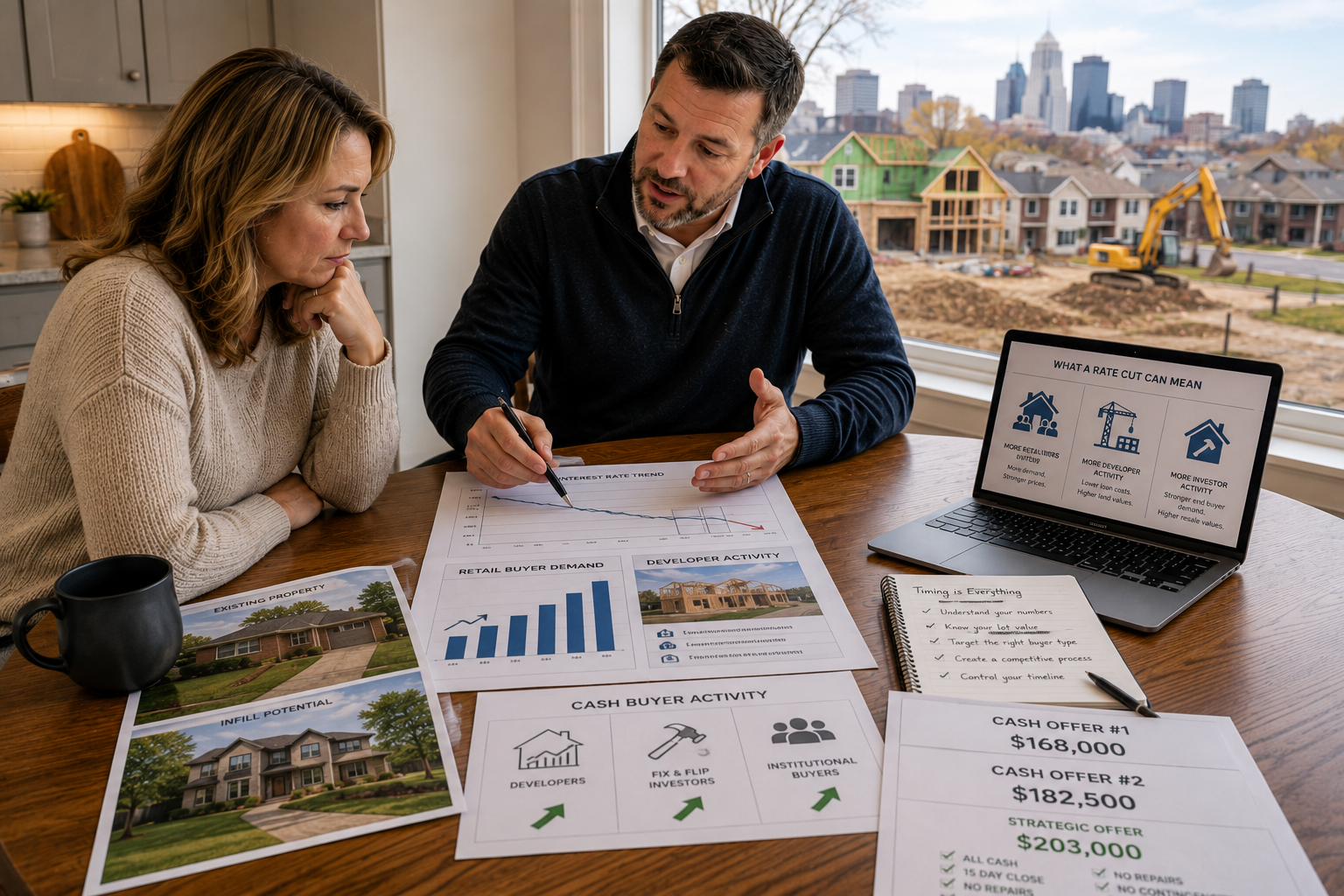
If the Federal Reserve cuts rates in the second half of 2026, the most visible effect will be a surge in retail buyer demand. Lower borrowing costs bring buyers off the sidelines and into active search mode. More buyers competing for the same inventory push prices up and tighten timelines. Sellers who have been waiting for the right moment will feel like their instinct was right.
But here is what the standard analysis misses. Developer activity does not slow down when rates drop. It accelerates. Construction loan costs fall alongside mortgage rates, which means developers can pay more for land acquisition and still hit the margins their model requires. The fix-and-flip investor pool also gets a boost, because the end buyers they are selling to can qualify for higher amounts and support stronger final prices.
The sellers who benefit most from a rate cut environment are actually the ones who have already locked in a competitive process before the market heats up. Once rates drop and every distressed property in Kansas City suddenly has three or four interested parties, the dynamic shifts. Sellers may see higher nominal offers, but they also lose the controlled negotiating position that comes from moving when demand is building rather than already peaked.
Getting into conversation with the right buyer type now, understanding your numbers clearly before rates move, and running a competitive process on your timeline rather than the market's timeline is the play that typically produces the strongest outcome.
How Heartland Homes KC Runs Both Sides of This Analysis
Most real estate agents can tell you what your house might list for. Very few can tell you what a developer would pay for the lot underneath it. Almost none have personal experience being the developer making that call and running that formula in real time.
I have been on both sides. I have built the homes that required acquiring teardown lots at the right number. I have underwritten the deals where paying $15,000 more for a specific lot was correct because of sight lines, corner position, and finished product positioning. And I have listed properties where the traditional retail market clearly outperformed any cash offer a developer would have made, and steered sellers toward that path instead.
The Heartland Homes KC process for sellers evaluating this decision starts with running both analyses simultaneously and putting them side by side. What does the property look like as a retail listing with our full marketing infrastructure driving competitive demand from qualified buyers? And what does it look like through the eyes of the right developer or investor buyer in the current market? You see both numbers, and you decide which path fits your situation, your timeline, and your goals.
That marketing infrastructure, what we call the 100-Point Marketing Plan, is what drives competitive tension in both scenarios. Whether you are selling to retail buyers or running a developer-facing process, more competition produces better terms. You can see exactly how that works at guaranteedsoldkc.com/heartland-homes-kc-100-point-marketing-plan.
If you want to move directly to a cash offer request before that larger conversation, you can do that right now at janaandjasondelong.proedgeinstantoffers.com/get-cash-offers.
What Do Cash Home Buyers in Kansas City Actually Pay? The Formula Behind the Number
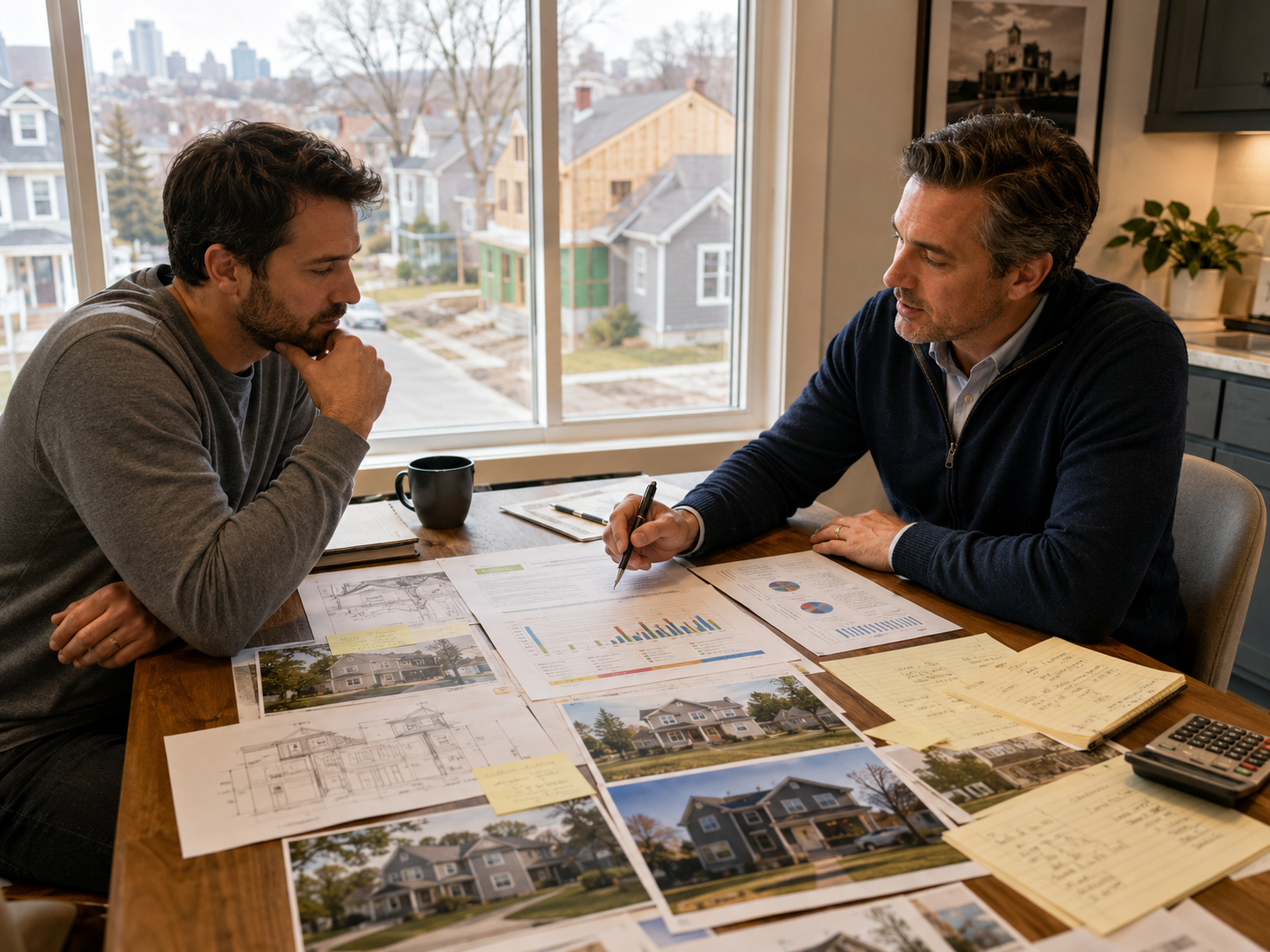
Sellers deserve to understand the math before they hear a number. Here is how each buyer type arrives at their offer.
New construction developers and infill builders in Kansas City typically target 65 to 70 percent of the after-construction value of the finished home, minus demolition, site preparation, permitting, carrying costs through the build period, and their required profit margin. In a submarket where finished new construction is trading at $500,000, that formula typically produces a maximum lot acquisition price in the $160,000 to $205,000 range depending on the specific cost structure of the project and the builder's current pipeline.
Fix-and-flip investors use a variation of the 70 percent after-repair value formula minus estimated rehabilitation costs. A home that would sell for $280,000 fully renovated with $65,000 in work required typically produces a maximum allowable offer in the range of $131,000 before the investor's margin. That ceiling is not negotiable in a meaningful way. An investor who pays above it loses money, and experienced local investors do not do that intentionally.
iBuyer and institutional platforms typically arrive near the 75 to 80 percent of market value range before service fees. Those fees run 5 to 8 percent of sale price, which brings the effective net to the seller down to something that often compares unfavorably to what a well-represented local process would produce. The convenience is real. The trade-off is also real, and it is worth quantifying before you sign anything.
Understanding which formula applies to your property is the starting point for evaluating any offer you receive. If you do not know which formula is in play, you have no basis for knowing whether the number on the table is fair, low, or something you should be competing for.
Cash home buyers exist at every price point across Kansas City. The question is not whether someone will buy your house. The question is whether the right buyer type is the one making you an offer, and whether you have enough information to know the difference.
I have built over 100 homes and flipped over 150 properties personally in this market. I have sat across the table from sellers as the buyer, and I have sat across the table from buyers as the seller's agent. That dual experience is what makes this analysis different from what most Kansas City real estate agents can offer you.
If you are thinking about a cash sale, a traditional listing, or you genuinely are not sure which path makes more sense for your specific situation right now, the conversation starts here at guaranteedsoldkc.com/schedule-call. No pressure, no obligation. Just a clear look at your numbers and what your options actually are.
Frequently Asked Questions: Who Buys Houses for Cash in Kansas City?
Who buys houses for cash in Kansas City for new construction?
Residential infill developers and new construction builders are the most active cash buyers targeting properties for new construction in Kansas City. They are buying for lot value and location, not the condition of the existing home. Their acquisition pricing is driven by finished product value in the neighborhood, not the repair cost of the current structure. Heartland Homes KC works with active developers across the metro and can help sellers understand whether their property is a candidate for this type of buyer.
How do I know if my house is worth more to a developer than to a retail buyer?
The clearest signal is whether new construction in your immediate neighborhood is trading above $400,000 to $450,000. At that price level, the teardown economics for a developer often work, and the lot value can exceed what a renovated retail listing would net after repairs, carrying costs, and commissions. A property evaluation that looks at both scenarios side by side is the most accurate way to answer this question for your specific situation.
What is the fastest way to get a cash offer on my Kansas City home?
Requesting a cash offer directly through Heartland Homes KC's Cash Offer+ program is the fastest path. The evaluation focuses on current market value, lot potential, and buyer type fit, not just a quick automated estimate. Most sellers receive an initial range within 24 to 48 hours of submitting their property details, and serious offers typically follow within a few business days.
Which Kansas City neighborhoods have the highest cash buyer demand right now?
Prairie Village, Leawood, and Weatherby Lake see some of the strongest developer acquisition activity in the metro because of high new construction price ceilings. The Northland along 152 Highway and I-29 is consistently active for move-up product. On the Missouri side, Hyde Park, Waldo, and Midtown Kansas City draw smaller-scale infill builders. Overland Park and Parkville round out the most active corridors for cash buyer competition.
Is it better to sell for cash now or wait for interest rates to drop?
This depends on your property type and timeline. If your home is a strong retail candidate, a rate cut increases buyer demand and may produce a higher list price result. If your property is a teardown candidate or has deferred maintenance that makes retail competition difficult, acting now in a controlled process with developer buyers may outperform a post-rate-cut scenario where those developers face more retail competition themselves. There is no universal answer, but running both scenarios with current numbers is the right starting point.


