
Relocating to Kansas City for Work: Your 90-Day 2026 Guide
You've got 90 days and one house-hunting trip. Here's how to not waste it.
If you're relocating to Kansas City for work, the clock started the day you signed your offer letter. HR wants a start date. Your family wants to know about schools. And you probably have one long weekend to pick a home in a metro that sprawls across two states and a whole grid of counties, cities, and school districts.
I'm Jason DeLong with Heartland Homes KC. I'm a Kansas City real estate agent with eXp Realty. Before that, I was trained as an architect at Kansas State University. I've built over 100 homes and flipped over 150 homes personally, so I know a thing or two about the process. I also built dozens of subdivisions across this metro, which means I've seen what's behind the drywall in a lot of the neighborhoods you're about to tour.
This is the playbook I'd hand a friend who just got transferred here. If you'd rather talk it through first, book a quick relocation strategy call with me and we'll map out your 90 days together.
Why Relocating to Kansas City for Work Makes Sense in 2026

Kansas City doesn't get the hype of Austin or Nashville. That's part of the appeal. You get a big-city job market, short commutes, and home prices that still make sense for a single paycheck or a two-income family.
Kansas City Job Market 2026 at a Glance
The Kansas City job market 2026 picture is steady, not frothy. The metro unemployment rate was 3.6% in July 2026, with more than 3,700 recent postings spread across more than 1,500 companies. That spread matters. Your career here isn't tied to one giant employer. callings
Here's where the hiring is concentrated:
Healthcare. It makes up roughly 30% of local postings, with The University of Kansas Health System and University Health among the most active employers. callings
Construction and engineering. Construction accounts for about 25% of postings. Big engineering firms like Burns & McDonnell and Black & Veatch call this metro home. callings
Advanced manufacturing. Panasonic's 300-acre plant in De Soto is the largest EV battery plant in the United States and brought thousands of jobs to the region. The company is also putting more than $2 billion into data center battery production there, with the first cells expected around 2028 or early 2029. kctv5kctv5
Automotive, government, and corporate. Ford's Claycomo assembly plant in the Northland, Honeywell's National Security Campus in south KC, Garmin in Olathe, and a long list of downtown corporate offices round it out.

Translation: if you're coming here for a job, there's a good chance there's a second job, or a spouse's job, within a 25-minute drive.
What the Housing Market Looks Like Right Now
Kansas City is more balanced than it was two or three years ago. That's good news for relocating buyers.
The Heartland MLS median sale price hit $349,900 in July 2026, up 3.9% from a year earlier. emetropolitan
Metro active listings reached 6,284 in August, with a median of 50 days on market. Inventory rose 2.1% from July while the median asking price dipped 2.5%. mojokcmojokc
Across the 19-county KCRAR region in August, the median sale price was $334,200 for existing homes versus $499,900 for new construction, and new homes sat roughly 107 days compared to 32. mojokc
What that means for you: you have more choices and more negotiating room than buyers did in 2022. But the well-priced homes in top school districts still move fast. You can't wing it.
The 90-Day Relocation Game Plan

Most relocating buyers blow their one trip because they show up with no filter. They tour 20 houses in five suburbs and fly home more confused than when they landed. Here's how to avoid that.
Days 1 to 30: Do the Heavy Lifting From Home
This is where the move is actually won.
Read your relocation package line by line. More on this below. Know what's covered before you spend a dollar.
Get pre-approved with a lender licensed in both Missouri and Kansas. You may not know which side of State Line Road you'll land on yet. Don't limit yourself.
Map your commute first, not your house. Pull up your office address and check drive times at 7:30 a.m. and 5:15 p.m. Draw a 25-minute circle. That's your search zone.
Rank your non-negotiables. School district, lot size, commute, budget. Pick your top two. Everything else is a tiebreaker.
Hire your agent now, not on the trip. You want someone watching listings, previewing homes, and sending you video walkthroughs for weeks before you get on a plane.
I analyze 10 to 12 investment deals a week. The same discipline applies here. By the time you land, your list should be cut down to your best 8 to 12 homes, not 30.
Days 31 to 60: Make the One Trip Count
Here's how I'd structure a three-day house-hunting trip.
Day 1: Drive the commute. Do it at rush hour, both directions. Eat dinner in the neighborhood you think you like. Kansas City neighborhoods can feel completely different from one mile to the next.
Day 2: Tour your shortlist. Group homes by area so you're not zigzagging across the metro. Take your own video in every house. They all blur together by house six.
Day 3: Second showings and write the offer. Go back to your top two. Then decide. You don't need to be in town for the inspection. Your agent can attend and walk you through it on video.

Days 61 to 90: Close From Anywhere
Once you're under contract, the rest can happen remotely.
Inspection and repair negotiation
Appraisal and final loan approval
Homeowners insurance quotes (ask about hail and roof age, this is Kansas City)
Utility setup (electric is mostly Evergy, gas is mostly Spire, water varies by city)
Remote or mail-away closing if your lender and title company allow it
Build in a buffer. If your start date is day 90, aim to close by day 75.
Best Commute Neighborhoods in Kansas City by Job Hub
The best neighborhoods in Kansas City for you depend on one question: where's your badge scan? Here's how I break down the best commute neighborhoods Kansas City has to offer, organized by where people actually work.
Downtown, Crossroads, and Crown Center
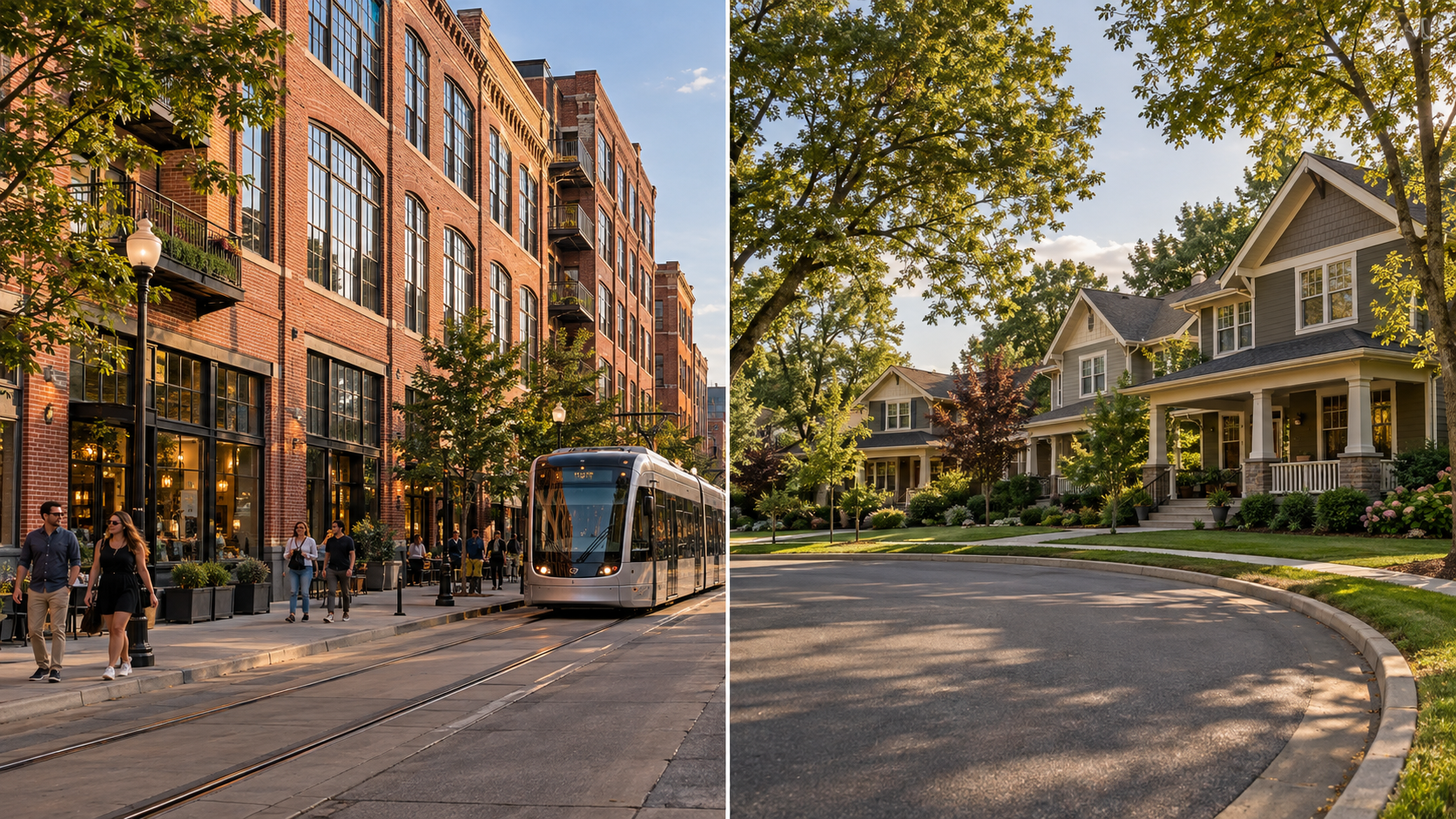
River Market and Crossroads. Lofts and condos, walkable, streetcar access.
Midtown, Brookside, and Waldo. Older homes with character and big trees. Quick drive downtown.
North Kansas City and the close-in Northland. Just across the river. Often a faster commute than people expect.
Overland Park, Leawood, Lenexa, and the I-435 Corridor
Overland Park and Leawood. Strong schools, established neighborhoods, easy access to the corporate campuses along I-435 and College Boulevard.
Lenexa and Shawnee. Newer construction, good value, and quick access to I-435 and K-10.
Olathe. Great fit for Garmin and the southern Johnson County employers.
De Soto and Western Johnson County
If you're headed to the Panasonic plant or one of its suppliers, look west.
De Soto itself, if you want small-town and a short drive.
Shawnee and western Olathe for more inventory and amenities.
Lawrence is a legitimate option down K-10 if you like a college-town vibe.
The Northland and KCI
This is my backyard. For the airport, Ford Claycomo, and the data center growth north of the river, the Northland makes a lot of sense.
Liberty and Kearney. Well-regarded schools and a small-town feel.
Parkville and Platte City. Rolling terrain, bigger lots, quick access to KCI.
Gladstone and the Northland suburbs. Solid value and short trips downtown.
Eastern Jackson County
Lee's Summit. Big draw for families, strong schools, easy access to US-50 and I-470.
Blue Springs. More house for the money, easy I-70 access east.
Want to see what's available right now in each area? Browse our featured listings by Kansas City neighborhood.
Missouri or Kansas? The State Line Decision

This is the question nobody warns you about when you're moving to KC from out of state. Kansas City sits on both sides of State Line Road. Same metro, two tax systems.
A few things to know:
Kansas City, Missouri has a 1% earnings tax. It applies to residents of KCMO and to people who work inside KCMO city limits. Live in Overland Park and work downtown? You'll likely still pay it.
Property taxes and assessments work differently on each side. Jackson County's recent reassessments caught plenty of homeowners off guard. Ask your agent for the actual tax bill, not just an estimate.
School districts don't follow city lines. A "Kansas City, MO" address could be in North Kansas City, Park Hill, Liberty, Center, or several other districts. Always verify the district by address.
Income tax rules differ between Missouri and Kansas. Run your specific numbers with a CPA before you commit to a side.
Don't pick a state by gut feel. Pick it by math plus commute.
Using Your Relocation Package for Home Buying
Relocation package home buying rules can make or break your budget. Every company does it a little differently, but most packages fall into three buckets.
The Three Common Package Types
Lump sum. You get a set amount and spend it however you want. Simple, but easy to burn through fast.
Managed or tiered. A relocation company handles things, and covers specific costs like closing fees, movers, and temporary housing.
Buyout programs. The company or its relocation firm buys your old home if it doesn't sell in time. This protects you from carrying two mortgages.
Questions to Ask HR Before You Do Anything
Do you cover buyer closing costs on the new home? Is there a cap?
Do you cover loan origination fees or discount points?
How many days of temporary housing do I get?
Is there a home-finding trip? How many days, and for how many people?
Is there tax gross-up on the reimbursed expenses?
If I'm selling a home, is there a buyout option or loss-on-sale protection?
Am I required to use a specific agent network, or can I choose my own agent?
One big warning: don't list your current home or accept an offer before your relocation company says it's okay. In many buyout programs, jumping the gun can cost you eligibility. Ask first, sign second.
Should You Buy or Rent First?
Both can work. Buying right away saves you a second move. Renting first gives you time to learn the metro.
If you want the middle path, a furnished mid-term rental for 30 to 90 days lets you start your job, drive the commutes for real, and buy with confidence. We run KC Furnished Stays for exactly this kind of transition, so ask me about it on your call.

What a Builder Sees That Most Buyers Miss
My architecture and building background changes how I walk a house. Here's what I tell every relocating buyer to watch for in Kansas City specifically.
Clay soils and foundations. A lot of the metro sits on expansive clay. Look for stair-step cracks, sticking doors, and uneven floors. Check how the yard grades away from the house.
Basement water. Most KC homes have basements. Look for efflorescence, fresh paint on only the bottom of walls, or a brand-new dehumidifier running hard.
Older home systems. In pre-1960s areas like Midtown and Brookside, ask about the electrical panel, plumbing type, and the sewer line. A sewer scope is cheap insurance.
Roof age and hail history. Kansas City gets hail. Roof age affects your insurance quote and your budget.
New construction incentives. New homes are sitting much longer than resale right now. That usually means builders will negotiate on rate buydowns, closing costs, or upgrades. Ask.
I don't say this to scare you. I say it because the right house with a known issue is often a better buy than the "perfect" house with a hidden one.
Moving to KC From Out of State: The Mistakes I See Most
Picking a house before picking a commute. Your drive is a daily tax on your time.
Assuming the mailing address tells you the school district. It doesn't.
Ignoring the state line math. Earnings tax and property tax can swing your monthly budget more than a small price difference.
Working with an agent who only knows one side of the metro. Kansas City is one market. Your agent should know both states.
Waiving the inspection to "win." With homes sitting around 50 days, you usually don't have to.
Touring too many homes on the trip. More options usually means worse decisions.

Already Live in KC and Your Job Just Moved?
Relocating for work doesn't always mean crossing the country. A new role in De Soto can turn a Lee's Summit commute into an hour each way. A Northland family might suddenly need to be in Johnson County.
If that's you, the order of operations matters. Most people can't comfortably buy the next home until the current one sells. That's where Heartland Homes KC's seller-first approach comes in. Instead of one path, you get options:
Know your number first. Get a free home value estimate so you know your real equity.
Compare a cash offer. If speed matters more than squeezing out every dollar, request cash offers on your home. We work with cash home buyers Kansas City sellers can trust, and you can close on your timeline.
Buy first, sell later. Our Trade-In Program helps you secure the next home before your current one hits the market.
Fix it and list it. If your home needs updates, we can handle repairs with no upfront cost to you so you net more.
Go full retail with a real plan. If you list traditionally, see how our 100-Point Marketing Plan builds demand before your home ever hits the MLS.
The goal isn't just the highest price. It's the highest net, on a timeline that fits your new job.
Frequently Asked Questions About Relocating to Kansas City for Work
Is Kansas City a good place to relocate for work in 2026?
Yes, for most professionals. Unemployment is low, hiring is spread across healthcare, construction, manufacturing, and corporate roles, and housing costs remain more manageable than most large metros.
How long does it take to buy a house in Kansas City?
Plan on about 30 to 45 days from accepted offer to closing with a mortgage. Cash purchases can close faster. Give yourself a buffer before your start date.
What are the best neighborhoods in Kansas City for commuters?
It depends on where you work. Overland Park, Lenexa, and Olathe fit the Johnson County corridor. Liberty, Parkville, and Platte City fit the Northland and KCI. Brookside, Waldo, and the Crossroads fit downtown.
Should I live in Kansas or Missouri if I work in Kansas City?
Run the numbers on both. KCMO's 1% earnings tax, property taxes, school districts, and your commute all factor in. There's no one right answer, but there is a right answer for your situation.
Can I buy a house in Kansas City before I move?
Absolutely. With video tours, a pre-screened shortlist, remote inspections, and mail-away closings, many relocating buyers only visit once. Some buy without visiting at all.
What does a relocation package usually cover for home buying?
It varies, but common items include closing costs, temporary housing, a home-finding trip, moving expenses, and sometimes a buyout program for your old home. Always get the details in writing from HR.
Let's Make Your One Trip Count

You don't get a do-over on this move. You get 90 days, one trip, and one shot at picking the right neighborhood for your family and your commute.
I'm Jason DeLong, and my job at Heartland Homes KC is to make that trip count. You get a Kansas City real estate agent who thinks like a builder and an investor, and who knows both sides of State Line Road.
Schedule your relocation strategy call and let's build your 90-day plan around your start date.


