
Kansas City Property Taxes 2026: A Seller's Guide | Heartland Homes KC
Kansas City Property Taxes 2026: What Sellers Need to Know Before Listing
The difference in property taxes between two $300,000 Kansas City homes can exceed $1,200 per year.
Here is what surprises most homeowners: you may not even need to cross the Missouri-Kansas state line to find that difference.
The property’s county, city, school district, fire district and other local taxing jurisdictions can create a significant difference between two homes with nearly identical market values. That difference can change a buyer’s monthly payment, affect what the buyer qualifies for and influence how your home compares with competing listings.
After more than two decades working in architecture, construction, development, renovation, investing and Kansas City real estate, I have learned that sellers often focus on the headline number: the list price.
Buyers do not experience your home as a list price. They experience it as a monthly payment.
That payment includes principal, interest, property taxes, homeowners insurance and sometimes mortgage insurance or association dues. Even when two houses are listed for the same amount, they may not be equally affordable.
If you are considering selling, schedule a seller strategy call with Heartland Homes KC. We can review your current property taxes, probable market value, selling expenses and estimated net proceeds before you commit to a particular strategy.
How Do Property Taxes Affect a Kansas City Home Seller?
Property taxes can affect a seller in four primary ways:
They influence the buyer’s total monthly payment.
They can affect how much a financed buyer qualifies to borrow.
They are normally prorated or credited between the seller and buyer at closing.
They can make one home appear more or less affordable than a competing property.
The Consumer Financial Protection Bureau defines a typical mortgage payment as principal, interest, taxes and insurance, commonly known as PITI. Fannie Mae also requires lenders to include real estate taxes when calculating the monthly housing expense used in a borrower’s debt-to-income ratio.
That is why Kansas City property taxes are not just a buyer issue.
A higher property-tax bill can narrow the buyer pool, create objections during showings and make the property more difficult to position against homes with lower total monthly costs.
A lower bill can be a legitimate marketing advantage, especially when buyers are comparing several Kansas City neighborhoods within the same price range.
The $1,200 Property-Tax Difference May Be Closer Than You Think
Many articles reduce the subject to Missouri versus Kansas property taxes.
In my opinion, that is too simplistic to be useful.
Missouri and Kansas calculate assessed value differently, but neither state has one universal property-tax rate. The final bill is created by the local jurisdictions serving that specific property.
Clay County’s published 2025 levy information illustrates the point. Its estimated residential rates varied substantially by tax area, ranging from approximately 4.5230 to 8.8809 per $100 of assessed value.
Missouri residential property is assessed at 19% of market value. On a home valued at $300,000, the assessed value would be $57,000.
Using the two Clay County tax-area rates as a simplified illustration:
A 4.5230 levy would produce an estimated tax of approximately $2,578.
An 8.8809 levy would produce an estimated tax of approximately $5,062.
The difference would be approximately $2,484 per year.
Those figures are an illustration using published estimated levies, not a quote for any specific property. Special circumstances, credits, exemptions, final certified rates, and individual property records can change the actual bill.
The larger lesson is that the phrase “Missouri taxes versus Kansas taxes” does not tell you enough.
You need the address.
Are Property Taxes Higher in Kansas or Missouri?
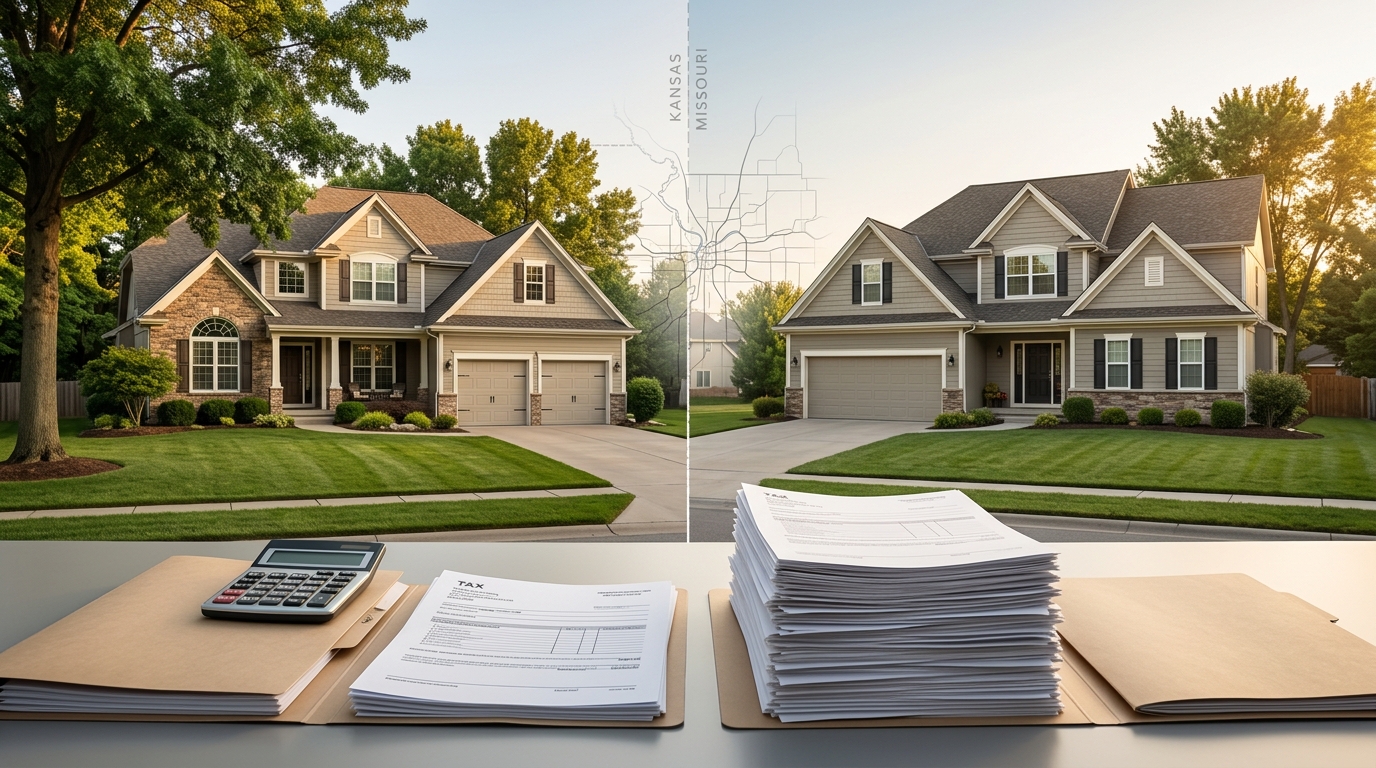
Not always.
Missouri and Kansas use different assessment percentages and different methods of expressing local tax rates.
A Kansas home can have a higher property-tax bill than a similarly priced Missouri home. A Missouri home can also have a higher bill than a Kansas property, depending on the taxing districts involved.
When I help a seller evaluate competition, I do not assume the home across the state line is cheaper or more expensive to own. I compare the actual tax history of the properties a buyer is most likely to consider.
That is the only comparison that matters in a real transaction.
How Missouri Property Taxes Are Calculated

Missouri residential real estate is assessed at 19% of its true market value. Local levies are then applied to that assessed value. The levy is generally expressed as an amount per $100 of assessed value.
For a home with a market value of $300,000:
Market value: $300,000
Residential assessment percentage: 19%
Assessed value: $57,000
Applicable local levies are applied to the $57,000
Missouri real property is generally reassessed in odd-numbered years. The value established for an odd-numbered year is ordinarily used again during the following even-numbered year unless there is new construction or another qualifying improvement. That means a Missouri property’s 2026 assessment is generally tied to its 2025 reassessment value.
The assessment is only one part of the bill. The tax levy can still change.
How Kansas Property Taxes Are Calculated
Kansas residential real estate is assessed at 11.5% of its appraised value. The applicable mill levy is then applied to that assessed value. One mill represents $1 of tax for every $1,000 of assessed value.
For a Kansas home appraised at $300,000:
Appraised value: $300,000
Residential assessment percentage: 11.5%
Assessed value: $34,500
Applicable mill levies are applied to the $34,500
The lower assessment percentage does not automatically mean the Kansas bill will be lower. Kansas taxing jurisdictions may apply a different collection of mill levies than the levies attached to a comparable Missouri property.
Kansas also appraises property annually. Johnson County reported that total appraised and assessed values increased approximately 6% for 2026, while about 68% of residential properties either increased by 7% or less or experienced a reduction.
Why the Final 2026 Tax Bill May Not Be Available Yet
One of the most important facts for homeowners researching Kansas City property taxes 2026 is that an appraised value is not the same thing as a final tax bill.
As of mid-2026, a property owner may know the county’s appraised value but still not know the final combination of local tax rates.
Johnson County specifically told homeowners that its 2026 Notices of Appraised Value were not tax bills. Cities, counties, school districts and other government bodies set the rates later in the process.
Wyandotte County explains that its current-year tax rates are not available until November because values are established first and local budgets and mill levies are approved later.
That creates an important challenge when listing a home during the spring or summer.
The most recent completed bill may be from 2025, while the buyer’s lender may need to estimate the 2026 amount using the current appraised value and available levy information.
My advice is to be transparent about what is known and what is still an estimate.
Do not advertise last year’s tax bill as though it is guaranteed to remain unchanged.
Why Buyers Care About the Tax Bill More Than Many Sellers Realize
When I first started building and selling homes, buyers talked more about purchase price than total monthly payment.
That has changed.
Today’s buyer can pull up a mortgage calculator while standing in the kitchen. Within seconds, that buyer is comparing the taxes, insurance, HOA dues and monthly payment with three other homes saved on a phone.
A seller may see a $300,000 home.
The buyer may see:
$1,900 in principal and interest
$350 in monthly taxes
$175 in insurance
$125 in mortgage insurance
A total housing payment that is no longer comfortable
The numbers will vary with the loan, down payment, interest rate, insurance and property, but the buyer’s decision is usually based on the complete payment.
Higher Taxes Can Reduce Purchasing Power

Fannie Mae requires lenders to include real estate taxes in the monthly housing expense used to calculate debt-to-income ratios. Lenders must generally use at least the current assessed value and may need to project taxes when a purchase, new construction or revaluation could result in a higher bill.
A difference of $100 per month may not sound dramatic to a seller.
To a buyer close to the lender’s qualification limit, it can be the difference between approval and denial.
It can also cause the buyer to reduce the purchase price, request a seller-paid credit or choose another property.
Buyers Compare Homes Across Multiple Taxing Districts
Kansas City buyers rarely limit themselves to one city boundary.
A Northland buyer might compare Kansas City, Liberty, Gladstone, Parkville, Smithville and Platte City. A Johnson County buyer may compare Overland Park, Olathe, Shawnee, Lenexa and Prairie Village.
Those homes can fall under different combinations of:
County government
City government
School district
Fire protection district
Library district
Ambulance or emergency service district
Special assessments
Community improvement districts
This is why searches for the best neighborhoods in Kansas City should consider more than sale prices and school ratings. The ownership costs attached to the property can vary considerably.
You can explore current homes and community information through our featured listings and Kansas City neighborhoods.
Can High Property Taxes Make a Home Harder to Sell?
Yes, but higher taxes do not automatically make a property undesirable.
A buyer may accept a higher tax bill when the property offers something valuable in return, such as:
A sought-after school district
Strong municipal services
Better parks, trails or public amenities
A convenient commute
A larger lot
Newer infrastructure
A lake, golf or community lifestyle
Historically strong resale demand
The seller’s job is not to hide the tax bill.
The seller’s job is to make sure the home’s value proposition is clear enough to justify the total cost.
In my experience, buyers become concerned when a cost feels unexplained. When they understand why one neighborhood costs more and what they receive in return, the discussion becomes much more rational.
Should You Lower Your List Price Because Property Taxes Are High?
Not automatically.
Property taxes are one factor in market value, but they are not the only factor.
A home with a larger lot, better location, stronger school district or major renovations may still sell for more than a lower-tax property. The problem arises when the home has a higher tax bill without offering a clear advantage over its competition.
Before recommending a price, I look at:
What buyers will compare with the property
The tax bills on the most relevant competing homes
The total estimated buyer payment
The property’s condition and updates
School district and neighborhood demand
Current active listings
Recent comparable sales
How much negotiating room the seller needs
The seller’s probable net proceeds
An automated valuation does not usually examine that complete picture. You can start by checking your Kansas City home value, but the final pricing decision should account for the home’s condition, location, competition and ownership costs.
Which Tax Number Should a Seller Use?
Use the most current, property-specific information available.
Before listing, I recommend gathering:
The most recent completed tax bill
The current county appraised or market value
The prior year’s appraised value
The property’s assessment history
Current exemption or credit information
Any pending appeal documentation
The exact taxing districts attached to the parcel
Available information about upcoming levies
The tax amount the buyer’s lender is likely to use
Do not rely solely on the amount collected through your mortgage escrow account.
An escrow payment may include:
An old tax estimate
A shortage from the prior year
An overage adjustment
Insurance premiums
A lender-required reserve
The escrow amount is not necessarily the annual property-tax bill.
Is a Kansas City Property Tax Calculator Accurate?
A Kansas City property tax calculator can provide a useful estimate, but it should not replace the actual county parcel record.
Online calculators often use county averages or general effective rates. Those averages may be useful for comparing broad areas, but they may not account for the specific city, school district, fire district, exemption or special assessment affecting your home.
For a property-specific estimate:
Look up the parcel through the county assessor or appraiser.
Review the most recent tax bill through the county collector or treasurer.
Confirm the property’s current appraised and assessed values.
Identify the taxing districts serving the address.
Ask the title company how taxes are likely to be estimated at closing.
Ask the buyer’s lender what tax amount may be used for qualification.
My opinion is simple: county averages are useful for writing articles. Parcel records are what matter when real money is on the line.
Should You Appeal Your Property Assessment Before Selling?
An appeal may be appropriate when the county’s value is not supported by the property’s condition or relevant comparable sales.
Common reasons to investigate an appeal include:
Incorrect square footage
A finished basement listed when the basement is unfinished
Bedrooms or bathrooms that do not exist
Improvements attributed to the wrong property
Significant structural or deferred-maintenance issues
Comparable sales that are materially newer or more updated
An appraised value that appears higher than probable market value
A property classification error
An assessment appeal and a real estate pricing strategy are not the same thing.
The assessor is determining value for taxation. The real estate market determines what a willing buyer is likely to pay. A successful tax appeal does not guarantee a higher sale price, and a high assessment does not prove that the home will sell for that amount.
Important 2026 Appeal Timing
Appeal deadlines vary by county.
Johnson County’s deadline to file a 2026 informal valuation appeal was March 27. Property owners who did not use that option may have another opportunity through payment under protest, but an owner may generally use only one of those county-level options during the tax year.
Jackson County’s 2026 Board of Equalization filing window ran from May 1 through July 13.
Because appeal rules are time-sensitive, contact the appropriate county office or a qualified property-tax professional before taking action. Do not assume the procedure in Jackson County is the same as Johnson, Clay, Platte or Wyandotte County.
What Is Property-Tax Proration at Closing?
Property-tax proration at closing is the process of allocating the applicable tax responsibility between the seller and buyer.
The purchase contract, closing date, available tax information and local closing practices determine the calculation.
When the current tax bill has not yet been issued, the title company may estimate the amount using:
The previous year’s tax bill
The current assessed value
An agreed percentage increase
Available levy information
A formula stated in the purchase contract
Assume a home has estimated annual property taxes of $4,000 and closes halfway through the year.
A simplified estimate might assign approximately $2,000 to the seller for the portion of the year the seller owned the property. Depending on when the taxes are due and whether they have already been paid, the adjustment may appear as a credit or debit on the closing statement.
The actual calculation may not be exactly half, because it can depend on the precise closing date, contract language, and local tax-payment schedule.
Do Sellers Pay Property Taxes at Closing?

Sellers are generally responsible for the agreed portion of property taxes attributable to their period of ownership.
That does not always mean the seller writes a separate check to the county at closing.
The amount may appear on the settlement statement as:
A debit against the seller’s proceeds
A credit to the buyer
A reimbursement to the seller
A tax payment made through the title company
An estimated adjustment subject to the contract terms
This is one reason the highest offer is not always the best offer.
The contract price may look attractive, but the seller must also consider credits, repairs, tax adjustments, financing risk and other closing expenses.
How Property Taxes Affect Your Seller Net Proceeds
When homeowners research seller closing costs in Kansas City, they often focus on commission and title fees.
Those are important, but they are not the entire calculation.
A realistic seller net sheet may include:
Contract price
Mortgage payoff
Other lien payoffs
Property-tax proration
Title and closing charges
Agent compensation
Buyer closing-cost concessions
Inspection-related repairs or credits
HOA charges
Municipal requirements
Home warranty expenses
Moving costs
Carrying costs through closing
The list price is not the number you keep.
I encourage sellers to evaluate every option based on three factors:
Estimated net proceeds
Probability of reaching closing
Time and inconvenience required
That framework is more useful than simply chasing the largest number printed on an offer.
A Kansas City Seller Story That Changed the Net by About $25,000
One of our Northland clients had owned the same home for approximately 54 years.
The house needed updating, and an investor-style as-is sale would have been the easiest option. There would have been fewer showings, no major renovation, and a relatively straightforward closing.
Rather than assuming the cash offer was automatically the right answer, we compared the likely outcomes.
We reviewed:
The probable as-is retail value
The investor alternative
Repairs the seller was willing to make
Repairs the seller did not want to make
Expected selling expenses
Closing adjustments
Timeline
Certainty
Probable net proceeds
We decided the home had enough appeal to test the open market without asking the seller to complete a major renovation.
Then the open house landed during a snowstorm.
I was not expecting a record turnout, but 11 buyers came through, and we received seven offers. The seller ultimately netted approximately $25,000 more than the investor alternative and closed in roughly three weeks.

Property taxes were not the largest number on that seller’s net sheet. They were still part of the calculation.
The broader lesson was that sellers should compare the complete outcome before choosing between a listing and a direct cash sale.
Listing is not always better. Cash is not always better.
The right decision depends on the property, condition, seller’s priorities, timeline, and actual net.
How to Compare a Traditional Listing With a Cash Offer

Homeowners searching for cash home buyers Kansas City often want one or more of the following:
No repairs
No showings
A predictable closing date
Less inspection risk
No buyer financing contingency
A quick sale
More privacy
Time to handle an inherited or distressed property
Those benefits have real value.
A traditional listing may produce a higher sale price, but it can also involve repairs, preparation, showings, concessions, appraisal risk and a longer timeline.
The correct comparison is not cash offer versus dream retail price.
It is:
Probable cash proceeds, certainty and convenience
Compared with:
Probable market proceeds after preparation, carrying costs, commissions, concessions and risk
Sellers who want to explore an as-is alternative can request cash offers for their Kansas City home and compare those numbers with a realistic open-market strategy.
Property Taxes Should Be Part of the Marketing Plan
Marketing is not only photography, video and advertising.
Good marketing begins with understanding what buyers may question about the property.
If a home has an unusually high tax bill, we need to know that before launch. If the tax bill is unusually low because of an exemption that may not transfer to the buyer, we need to understand that too.
Our Heartland Homes KC 100+ Point Marketing Plan is designed to create early attention, communicate the property’s value and prepare for buyer objections before they weaken the seller’s negotiating position.
For property taxes, that preparation may include:
Verifying the current parcel information
Reviewing the assessment history
Comparing competing homes’ taxes
Identifying an exemption or abatement
Calculating the approximate monthly difference
Explaining what the neighborhood provides for the cost
Giving buyers accurate documentation
Avoiding claims about a future bill that cannot yet be verified
Accuracy builds confidence.
A buyer who discovers incorrect tax information may start wondering what else was overlooked.
My Opinion as a Kansas City Real Estate Agent
Property taxes should not scare a seller into underpricing a home.
They should also not be ignored.
I have built more than 100 homes, renovated more than 150 properties, and participated in more than 1,000 real estate transactions. That experience has taught me to look at a home from several angles at once: construction, condition, marketability, financing, investment value and resale.
A tax bill is one piece of that evaluation.
It does not determine the entire value of a home, but it can influence how the buyer experiences that value.
A strong Kansas City real estate agent should be able to explain:
How your taxes compare with your competition
What buyers are likely to see in their projected payment
Whether the current assessment deserves a closer look
How taxes may be handled at closing
How the adjustment affects your net
Whether a cash sale or market listing better fits your priorities
The goal is not simply to sell the property.
The goal is to help you make the right financial decision before the property is sold.
Frequently Asked Questions About Kansas City Property Taxes 2026
How Much Are Property Taxes on a $300,000 Kansas City Home?
There is no single Kansas City-wide answer.
The bill depends on the state, county, city, school district, other taxing jurisdictions, appraised value, assessment classification, exemptions and local levies attached to the address.
Two $300,000 homes can have annual bills that differ by more than $1,200.
Are Kansas Property Taxes Always Higher Than Missouri Property Taxes?
No.
Kansas and Missouri use different assessment formulas, but the final bill depends on local rates. A Kansas property may have a higher bill than a Missouri property, but that is not true for every address.
Compare the specific properties rather than relying on a statewide assumption.
Will Selling My Home Cause the Property Taxes to Increase?
A sale does not create one universal automatic increase across the entire Kansas City metro.
However, the sale may become market evidence used in a future appraisal or reassessment. New construction, improvements, expiring exemptions, and local valuation procedures can also affect future taxes.
The buyer should verify future estimates with the county and lender.
Is Assessed Value the Same as Market Value?
No.
Market or appraised value is the county’s estimate of the property’s value. Assessed value is the portion of that amount to which the tax rate is applied.
The home’s likely selling price is determined by current market competition and buyer demand, not simply by the county assessment.
Can I Use My Tax Assessment to Set My Listing Price?
I would not recommend it.
The assessment may be higher or lower than the property’s probable open-market value. A pricing analysis should use relevant sales, active competition, condition, location, updates, and current buyer behavior.
Can a Buyer Back Out Because the Taxes Are Higher Than Expected?
The answer depends on the purchase contract, financing contingency, disclosures, and the circumstances of the transaction.
A higher tax estimate can affect loan qualification or the buyer’s willingness to proceed. Accurate information at the beginning reduces the likelihood of a late surprise.
What Happens to My Tax Exemption When I Sell?
Some exemptions, rebates, freezes, or credits are based on the current owner’s eligibility and may not transfer to the buyer.
Do not assume the buyer will receive the same tax treatment. Verify the program with the county or appropriate agency and disclose the situation accurately.
Should I Appeal My Assessment Before Listing?
Consider it when the county record is inaccurate or the appraised value appears unsupported by the home’s condition and comparable sales.
Because deadlines and procedures vary, contact the county promptly. Do not wait until a few days before listing.
Are Property Taxes Included in a Seller Net Sheet?
They should be.
A well-prepared seller net estimate should include an estimated property-tax proration along with mortgage payoff, title expenses, concessions, compensation and other likely closing costs.
Know Your Probable Net Before You Put Up the Sign
Kansas City property taxes 2026 are more than a line on a county website.
They can influence:
The buyer’s monthly payment
The buyer’s mortgage qualification
How your home compares with competing listings
Offer negotiations
Property-tax proration at closing
Your final net proceeds
The most important number is not necessarily the list price.
It is the amount you are likely to keep after the transaction is complete.
At Heartland Homes KC, Jana and I help sellers compare traditional listings, as-is sales, improvement strategies, and cash-offer alternatives. Our goal is to show you the likely outcome of each path so you can make the decision with real numbers instead of assumptions.
Schedule your seller strategy call to review your property’s estimated value, current tax position, selling options and probable net proceeds.
This article is for general educational purposes and is not legal, accounting, lending or tax advice. Property valuations, exemptions, levies, appeal procedures and closing calculations vary by property and jurisdiction. Consult the appropriate county office, title company, lender, attorney or tax professional regarding your specific situation.


