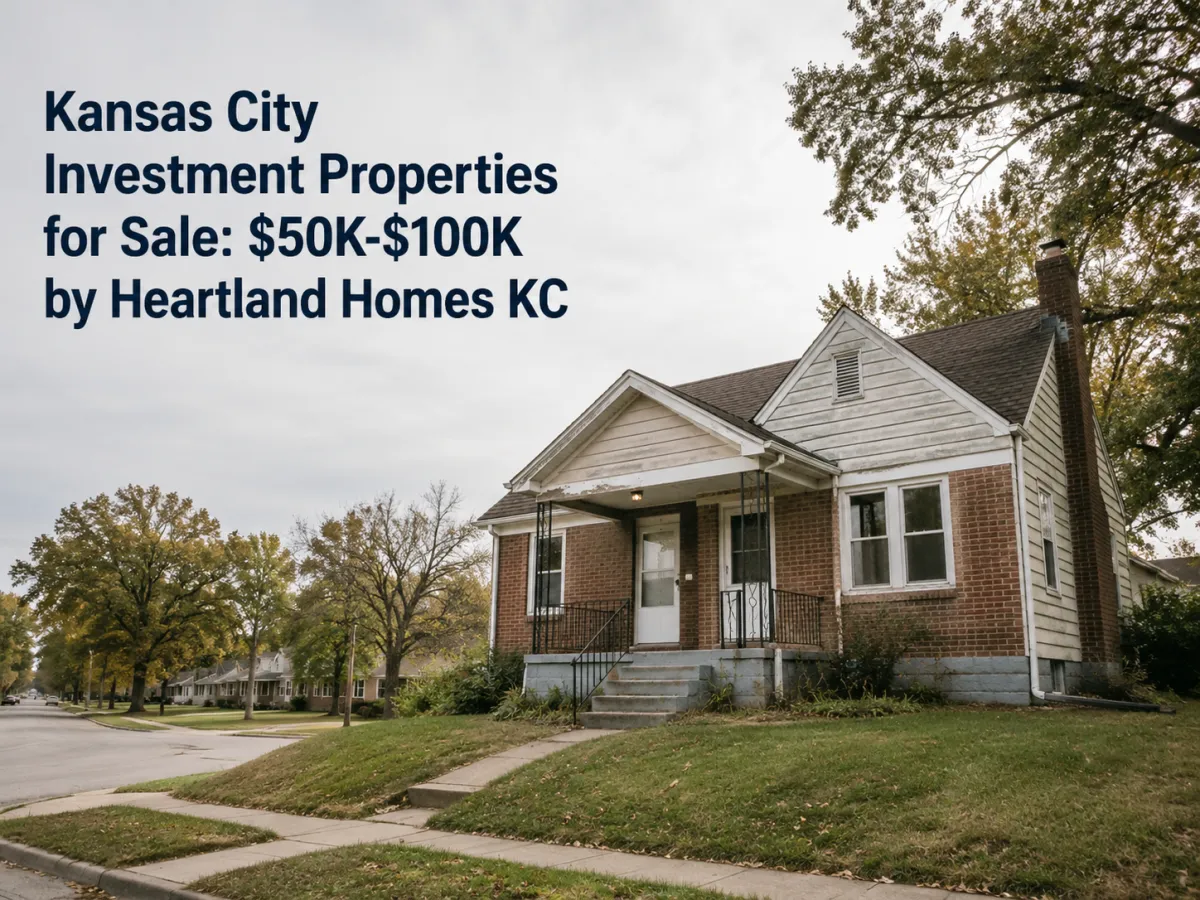
Kansas City Investment Properties for Sale: $50K-$100K by Heartland Homes KC
Kansas City Investment Properties for Sale: What a $50K–$100K Budget Gets You
Most people hear "fifty to a hundred grand" and assume it buys nothing but headaches in real estate. In Kansas City, it still buys a cash-flowing asset. That is the quiet advantage of this market, and it is closing a little more every year as the rest of the country catches on.
Finding Kansas City investment properties for sale in the $50,000 to $100,000 range usually means targeting distressed single-family homes or small multifamily units. At that budget, you are buying wholesale deals and value-add properties in emerging neighborhoods, then forcing equity through a BRRRR or fix-and-flip. Do it right, and a $75,000 all-in single-family in KC can pencil to roughly 7 to 9 percent cash-on-cash before leverage. The catch is that the best deals almost never hit the open MLS, which is exactly where a specialized Kansas City real estate agent earns their keep.
I've built over 100 homes and flipped over 150 homes personally, so I know a thing or two about the process. I also underwrite ten to twelve deals a week, so the numbers below are not theory; they are what I see close. If you want to skip the reading and just talk through your buy box, book a call here: https://guaranteedsoldkc.com/schedule-call. Otherwise, let's get into it.

Navigating the $50K to $100K Kansas City investment landscape
Kansas City consistently ranks among the most affordable major metros in the country for investors, sitting well below the national median home price. That affordability is not a gimmick. It is the reason out-of-state money keeps flowing into KC and the reason a modest budget still works here when it would not in Denver, Nashville, or Austin.
Here is what $50,000 to $100,000 all-in actually buys in 2026. All-in means purchase, rehab, and closing combined, not just the sticker price.
Distressed single-family homes. This is the core of the strategy. Think C-class houses in Kansas City, Kansas neighborhoods like Victory Hills, Riverview, and Turner, or east-side KCMO pockets like Marlborough, Ruskin, and Hickman Mills. You buy at $40,000 to $70,000, put in $20,000 to $35,000 of work, and land under $100,000 on a home that rents for $950 to $1,200.
Wholesale contracts. Instead of buying the house, you buy the contract. A wholesaler locks a distressed property under contract and assigns it to you for a fee. You inherit a below-market purchase price without ever hunting the deal yourself. The trade-off is that you are trusting someone else's numbers, which is where an experienced set of eyes matters.
Small multifamily. Duplexes in rougher pockets occasionally land at the top of this range when they are distressed. Two doors under one roof spread your vacancy risk and often beat a single-family home on gross yield.
One thing today's rates quietly hand you: mortgage rates in the high-6 to low-7 percent range have cooled owner-occupant buyers, which means less competition and more room to negotiate on the exact properties investors want. The frenzy is gone. Patient money wins right now.
Why distressed singles and wholesale deals offer the best ROI
The reason distressed property beats a clean turnkey house comes down to one formula I run on every deal:
Maximum Allowable Offer equals 70 percent of After-Repair Value, minus repairs.
If a home will be worth $135,000 fixed up and needs $32,000 of work, your target buy is around $62,500. That built-in spread is your margin, your safety net, and your forced equity all at once. A turnkey house priced at retail hands that spread to the seller. A distressed house lets you keep it.
This is where my background does real work for clients. I have an architecture degree and I have physically built over 100 homes, so when I walk a distressed property I am not guessing at the rehab number. I can see whether that sagging floor is a $2,000 fix or a $20,000 problem before you ever write the offer. Getting the repair estimate wrong is the single fastest way to turn a good KC deal into a bad one, and it is the mistake I watch new investors make most.
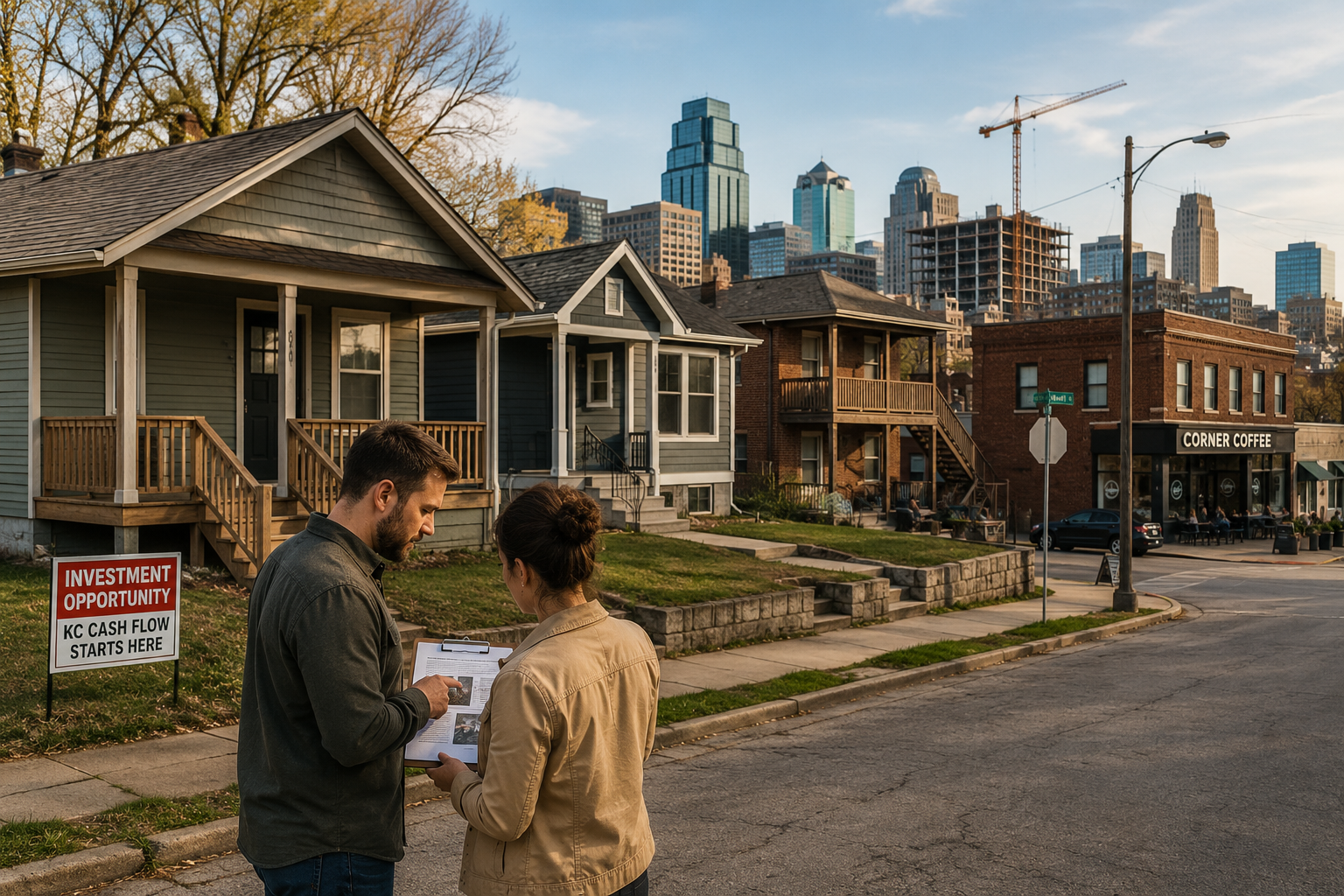
Top Kansas City neighborhoods for entry-level portfolios
Not every affordable neighborhood is a good investment. The ones worth your money show multiple signs of momentum at once: new rehabs, fresh retail and coffee, public investment, and rising rents. A few areas standing out in 2026:
Historic Northeast. This is the appreciation play on the list. In late 2025, construction broke ground on the Hardesty redevelopment, a roughly $400 million transformation of a former federal complex. When that much capital lands in one neighborhood, the early buyers benefit. Entry prices are still reasonable, but that window narrows every quarter.
Independence. A steady workhorse for cash flow. Median prices sit around the low $200,000s with strong recent appreciation, a deep tenant base, and rent-to-price ratios that support positive cash flow from day one. Plenty of B and C-class single-family inventory to choose from.
Marlborough and South KC. Some of the lowest entry prices in the metro, with homes still available well under $160,000 and distressed deals below that. Good hunting ground for the $50,000 to $100,000 buyer.
Kansas City, Kansas. Wyandotte County is the affordability engine, and it has a tool most investors overlook. The Neighborhood Revitalization Act can rebate up to 95 percent of the property tax increase from your improvements for a set number of years. Translation: you rehab or build, the value jumps, and you are not immediately taxed on the full jump. That is a real return booster if you know how to use it.
The Northland corridor. Higher entry prices, but major employment and data-center investment in the north metro are pulling long-term rental demand up with it. More of an appreciation-and-stability play than a cheap-entry play.
Want to see what finished homes actually sell for in these areas before you set your buy box? Start with current comps here. Pricing against reality instead of a Zestimate is half the battle.

Evaluating cash flow vs appreciation in KC
Every investor eventually has to pick a lane, and KC lets you play both. Here is the honest framing.
Cash flow first. Independence, KCK, and the east-side KCMO neighborhoods give you the strongest rent-to-price ratios. A $95,000 all-in single-family rental at $1,150 can throw off real monthly income. This is the lane for investors who want their money working now.
Appreciation first. Historic Northeast and the Northland lean on future value. Rents may be tighter today, but the neighborhood trajectory is the point. This lane rewards patience and a longer hold.
Now the part most articles skip. At 2026 interest rates, leverage compresses your monthly cash flow. If you buy that $95,000 house in cash and rent it at $1,150, after taxes, insurance, management, maintenance, and vacancy, you are looking at roughly 7 to 8 percent cash-on-cash, clean and simple. The moment you finance it at 7 percent, your monthly cushion shrinks fast. That does not make leverage wrong; it makes it a decision. Know which one you are optimizing for before you buy, not after.
Case study: turning $95,000 into a self-funding rental
Here is a deal representative of what I run for investor clients, with the kind of numbers you can actually expect in a KC C-class neighborhood.
The property came to me off-market, a tired three-bedroom bungalow a seller wanted gone fast. Purchase price was $58,000. My rehab scope, priced from my own build experience rather than a contractor's padded guess, came in at $32,000 for roof, systems, kitchen, bath, flooring, and paint. Add roughly $5,000 in closing and holding costs, and the all-in was $95,000.
After-repair value came in at $135,000. Market rent was $1,150 a month.
Two ways to play it from there.
Hold it in cash. All-in $95,000, net cash flow around $595 a month after every expense, which is about 7.5 percent cash-on-cash with zero debt and full flexibility. Boring, durable, and it sleeps well at night.
Run the BRRRR. Refinance at 75 percent of the $135,000 value, and you pull roughly $101,000 back out, recovering nearly your entire investment to go buy the next one. The trade-off, and I am going to be straight with you, is that at today's rates, the refinanced version cash-flows thin. You are recycling capital, not maximizing monthly income. Plenty of smart KC investors deliberately leave $10,000 to $15,000 in the deal to keep it comfortably positive.
Neither answer is wrong. The right one depends on whether you are building a portfolio fast or building income steadily. That is the conversation, and it is the one a good agent should be having with you before you sign anything.
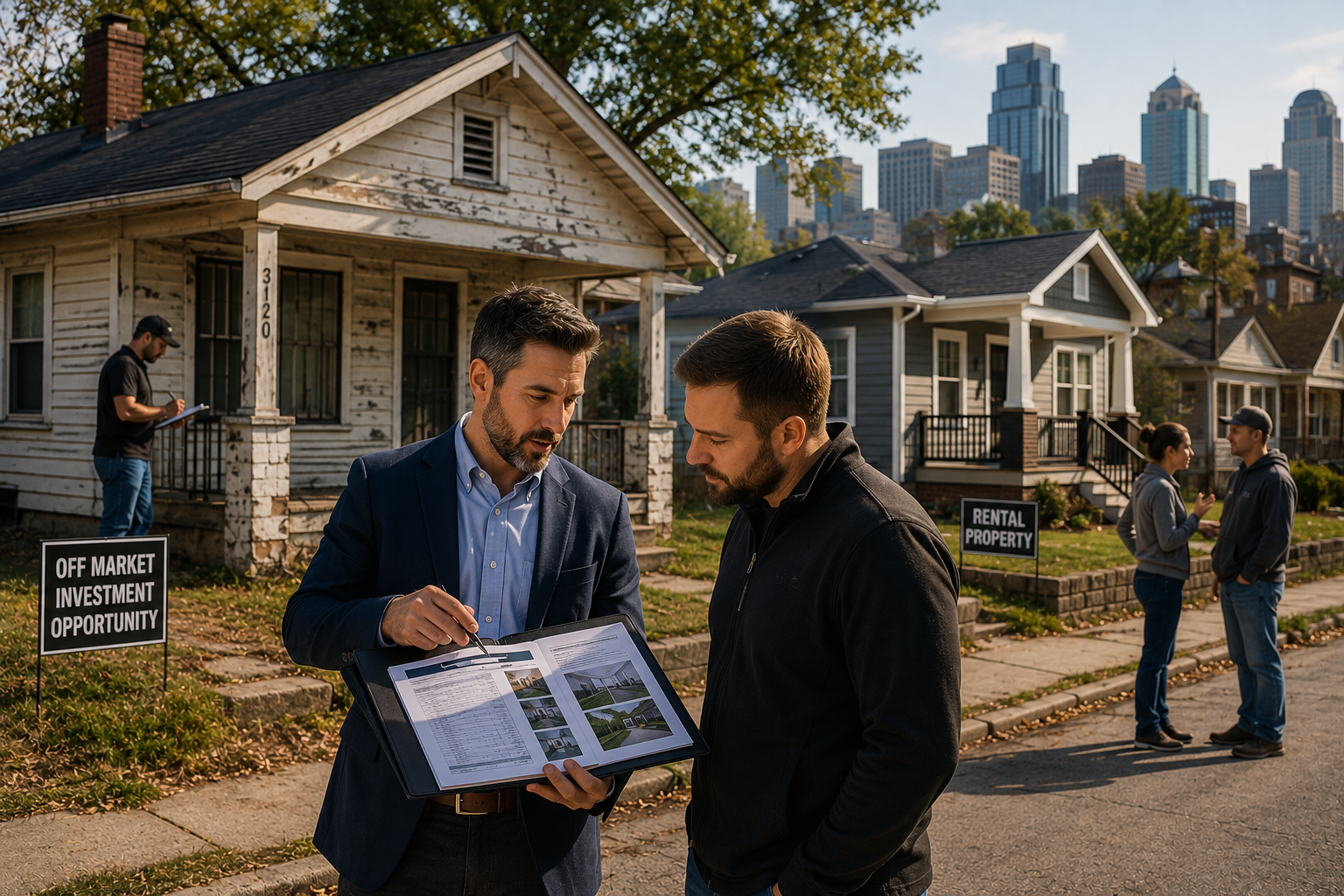
How to partner with the best realtor in Kansas City for off-market deals
The deals in that $50,000 to $100,000 range rarely reach the public MLS. By the time a distressed property is listed for everyone to see, the margin has usually been bid away. The winning inventory moves through relationships: wholesalers, other investors, agents who also invest, and sellers who take a cash offer and never list at all.
That last one is a channel most buyers never see. When a distressed seller takes one of our cash offers, the properties that fit a buy-and-hold strategy get routed to the investors on my list before they hit the market. If you want to understand how the seller side actually works, this guide breaks it down. And if you are an investor who also has a property to move, you can pull a no-obligation cash number here.
Two more things a genuinely useful Kansas City real estate agent does for an investor at this level. First, they run real rehab and ARV numbers, not optimistic ones, so your MAO holds up. If you want to gut-check what a finished property will appraise for, start here. Second, they know the two-state rulebook. Missouri and Kansas have different landlord-tenant laws, and Kansas City, Missouri, requires rental registration through its Healthy Homes program with specific tenant-screening rules. Miss that, and your cash-flowing asset becomes a compliance headache.
This is the part I care about most at Heartland Homes KC. The same discipline I bring to marketing a listing, I bring to sourcing and vetting a deal. If you want to see the level of rigor behind how we operate, look at the system here.
Frequently asked questions
What are the best neighborhoods in Kansas City for rental properties under $100,000?
The strongest entry-level rental neighborhoods are Independence, east-side KCMO pockets like Marlborough and Hickman Mills, and Kansas City, Kansas, areas like Victory Hills and Turner. These offer the lowest acquisition prices in the metro, paired with rent-to-price ratios that support positive cash flow.
How do I find wholesale Kansas City investment properties for sale?
Wholesale deals move through relationships, not public listings. Build connections with local wholesalers, get on investor buyer lists, and work with an agent who invests and gets first look at distressed and off-market properties. That access is the whole game at this price point.
Should I work with a Kansas City real estate agent for off-market deals?
Yes, especially one who is also an investor. They can accurately estimate rehab and after-repair value, route off-market and pre-MLS deals to you, and keep you compliant across Missouri and Kansas landlord-tenant laws. The right agent is the difference between a property that cash-flows and one that bleeds.
What is the average ROI for a $75,000 investment property in KC?
A $75,000 all-in single-family rental, around $1,000 to $1,150, typically pencils to roughly 7 to 9 percent cash-on-cash before leverage. A BRRRR refinance can recycle most of your capital for the next deal, though at 2026 rates, leverage compresses monthly cash flow, so many investors leave a little money in to stay comfortably positive.
Ready to move before everyone else?
The best Kansas City investment properties for sale never wait around, and they rarely announce themselves on the MLS. Contact Heartland Homes KC to get on the investor list and see distressed and off-market deals before they go public. Jason DeLong brings a builder's eye, an investor's math, and a full-time agent's access to every deal, so you buy right the first time. Book your strategy call here.


