
How Much Do Real Estate Agents Make in Kansas City? (2026 Guide)
How Much Do Real Estate Agents Make in Kansas City in 2026?
Ask ten websites how much do real estate agents make and you will get ten different answers. One salary site will tell you $80,000. Another will show $149,000. A third will say $46,000. All of them are technically pulling real data. All of them are misleading.
I have been a licensed Kansas City real estate agent since 2007. Before that I earned an architecture degree and spent years building and flipping hundreds of homes across this metro. I have watched agents make $300,000 in a year and I have watched agents quit after eight months with nothing to show for it. Same market. Same year. Wildly different outcomes.
So let me give you the honest income picture. Not the median. The truth, broken down by production level, with the Kansas City math attached. If you are weighing this career or trying to grow inside it, this is the version nobody with a course to sell wants you to read. Want to talk through your own numbers directly? Book a strategy call here.
Why the Average Realtor Salary Is a Trap

The first thing to understand is that a real estate agent is not an employee. Roughly 87% of agents are independent contractors, not salaried staff. There is no paycheck. You eat what you kill. That single fact breaks every "average salary" number you see online.
The Numbers Do Not Even Agree With Each Other
Look at the realtor salary Kansas City data floating around right now. ZipRecruiter puts the average near $80,690. Indeed shows around $89,394. Glassdoor lists realtor pay closer to $149,000. Another survey firm lands near $69,570.
These are not small gaps. They are off by tens of thousands of dollars. Why? Because these tools scrape job postings and self-reported numbers. They blend salaried leasing agents, brokerage staff, and part-timers into the same bucket. The sample sizes are tiny. The data is noise dressed up as a fact.
Ignore all of it. A single average cannot describe a commission-only career.
Commission Income Is Not a Bell Curve
Here is the part that matters. Agent income is not a smooth bell curve where most people cluster near the middle. It is bimodal. A large group makes almost nothing. A smaller group makes a lot. The "average" sits in a valley where very few agents actually live.

The national data proves it. The median gross income for agents landed at $59,200 in the most recent full year. But agents in their first two years reported a median of just $8,000. Agents with 16 or more years of experience reported a median of $88,500. Same profession. The gap is the whole story.
So when you ask how much do real estate agents make, the real answer is a question back at you. At what production level?
Gross Income Is Not What You Keep

Before we break down tiers, kill one more myth. Gross commission income is not take-home pay. Not even close.
A single closing gets carved up before it reaches your bank account:
The commission splits with your broker based on your agreement
Brokerage fees, franchise fees, and transaction fees come off the top
Errors and omissions insurance, MLS dues, and association fees are ongoing
You pay for your own leads, marketing, signs, photography, and CRM
You owe self-employment tax on what is left, and nobody is withholding it for you
Median business expenses for agents recently ran around $9,530 a year, and that is before splits. A rookie who "made $40,000 gross" might keep half of that after everything. Plan for it or the first year will bury you.
How Much Do Real Estate Agents Make in Kansas City by Production Level

This is the breakdown that actually helps you. I am translating national tiers into Kansas City reality, because our price points and commission math are specific to this metro.
Real Estate Agent Income in the First Year
Let me be blunt about real estate agent income first year, because false hope kills more careers than a bad market ever will.
Most first-year agents make very little. Nationally, a large majority of agents with two years or less of experience earn under $10,000. That is not a typo. Many close zero to three deals their first year while they build a database and learn to actually sell.

In Kansas City, a committed first-year agent who treats this like a business, not a hobby, can realistically close a handful of deals. At our price points that might mean $15,000 to $40,000 gross. Subtract splits and expenses and the take-home is modest. The agents who starve are the ones who bought a license and then waited for the phone to ring.
The First Fully Committed Year
There is a difference between "year one" and "the first year you go all in." Agents who lead-generate daily, follow a system, and stop treating floor time as a strategy tend to close 8 to 12 sides once they hit their stride.
At Kansas City averages, that is a real income. Not glamorous, but real. This is the make-or-break tier. Roughly 15% of agents are brand new every year and a similar share exits the business annually. This is the most fluid profession in the country. Survive 24 months with a system and you have already beaten most of your competition, because they will be gone.
Established Agents at Three to Five Years
This is where the career starts to pay. Established Kansas City agents in this range commonly land somewhere in the low six figures gross when they have a working lead engine and repeat clients feeding them.
The national median for experienced agents sits near $88,500, and in a metro with our transaction volume the strong operators clear that. The separator is not talent. It is consistency, listings, and a database that sends referrals without being chased.
Top Producers and Team Leaders
The ceiling is genuinely high. Top individual producers and team leaders in Kansas City run well into the multiple six figures. Team-based specialists nationally reported median sales volume around $17.5 million compared to $2.7 million for solo agents. Volume compounds.
What separates this tier is leverage. They are not selling harder. They built a machine: lead generation, a conversion process, listings that generate more leads, and often a team plus rev-share income. This is the difference between a job and a business. My listing clients get a 100-plus point marketing plan precisely because listings are the flywheel that top producers ride.
What Actually Determines Your Income

Notice what I have not blamed once: the market. New agents love to blame the market. Producers know their income is decided by a few controllable levers.
Lead Generation and Conversion
Income is a function of appointments, and appointments are a function of conversations. No leads means no deals means no income, in any market. The agents who win commit to a lead source and work it deeply instead of dabbling in ten things badly. Expired listings, for-sale-by-owner, distressed sellers, and cash offer leads all convert if you actually run the plays.
Listings Versus Buyers
Buyers can eat your calendar. Listings scale. A listing markets itself, generates buyer leads, and pays whether that specific home sells to your buyer or not. If you want to raise your income ceiling, shift your mix toward sellers. This is the entire reason I built Heartland Homes KC around a seller-first strategy that gives sellers multiple options instead of one path.
Your Split, Your Cap, and Your Model
Two agents can close the exact same number of deals and keep dramatically different amounts. Your brokerage model decides that. A punishing split quietly steals a huge chunk of your income every year. Cap structures, fees, and whether your brokerage offers rev-share or equity all compound over a career. Do not pick a brokerage on vibes. Run the annual math.
The Kansas City Angle: What a Deal Actually Pays
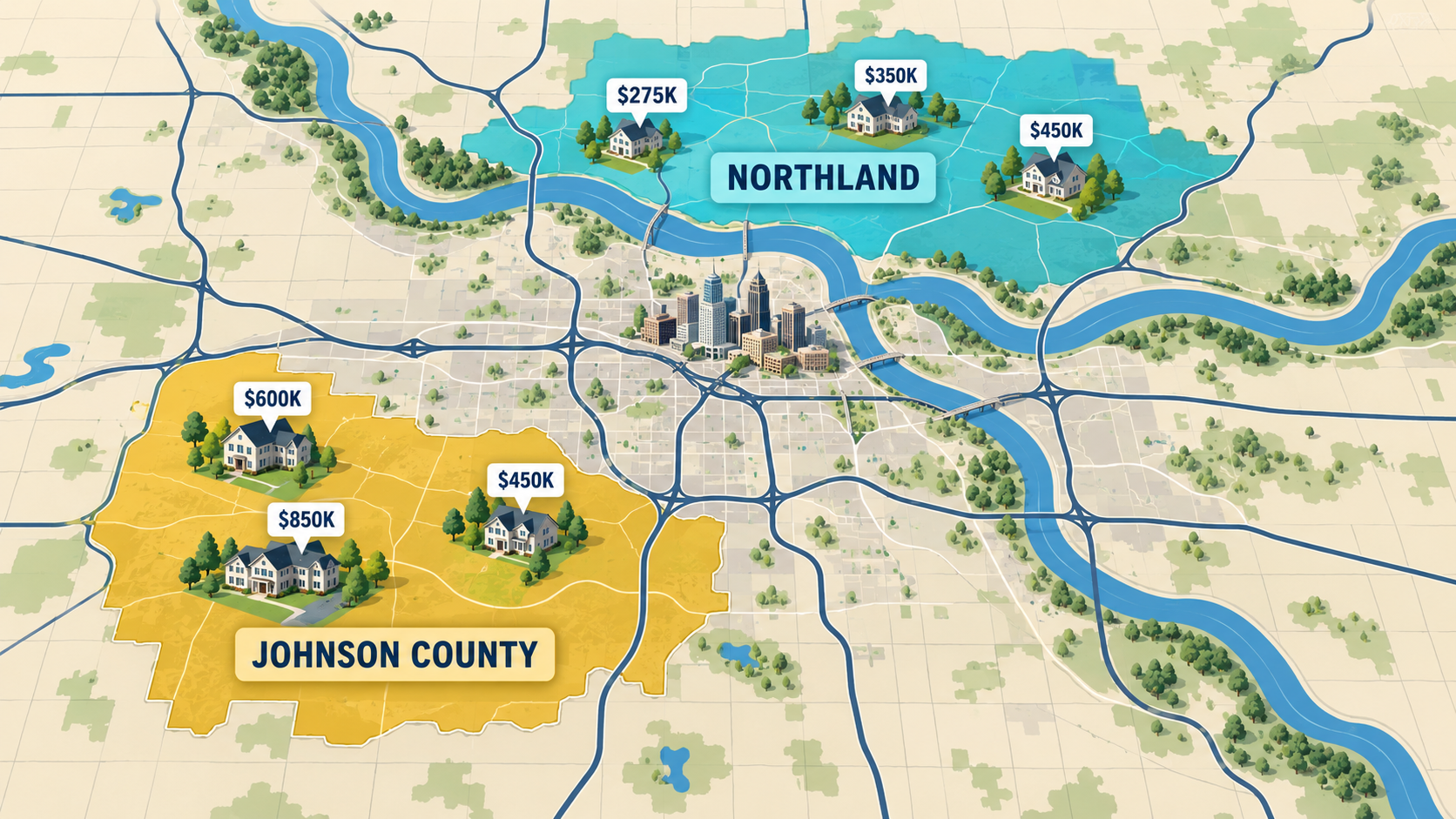
Let me put concrete math on it. Say you close a $300,000 home, a very normal Kansas City price point. A 3% listing side is $9,000 gross. Now apply your split and cap and fees. You might personally keep $5,000 to $7,500 on that closing, before taxes and marketing costs.
To build a $100,000 gross year at that price point, you need roughly 11 to 14 closings. That is one deal a month plus a couple extra. Very achievable with a system. Nearly impossible while winging it.
Price points shift across the metro, which changes your per-deal math. Johnson County and premium suburban markets carry higher price tags and bigger checks per deal, but also more competition. The Northland and value pockets move faster and let you build transaction count. Knowing the best neighborhoods in Kansas City for your niche is not trivia. It is income strategy. You can see how I map current inventory across Kansas City neighborhoods here.
One more Kansas City reality worth naming. A slice of sellers here do not want the traditional listing dance at all. They want speed and certainty. That is why serious operators also learn the cash side of the market. Being able to compete with cash home buyers in Kansas City, or bring a real offer yourself, wins listings that a one-trick agent loses. If you are a seller reading this, you can request a cash offer here or check your home value first.
Is Real Estate a Good Career in 2026?

Here is my honest take on whether real estate is a good career in 2026, from someone with skin in the game and no course to sell you.
It is a fantastic career for the right person and a brutal one for everyone else.
The case for it is strong. The income ceiling is uncapped. There is no boss and no salary cap holding you back. You can build multiple income streams off one license: retail sales, investing, buy-and-hold rentals, short-term rentals, development, and agent rev-share. Despite a slower market, most agents plan to stay in the business, which tells you the long game is real.
The case against it is just as real. There is no floor either. Roughly one in seven agents exits every year. The first year pays almost nothing while your expenses are very real. If you need predictable income by next month, this is the wrong move.
My blunt filter: real estate rewards operators who build systems and punishes people looking for an easy commission. The agents I recruit into my eXp rev-share organization tend to think like builders, not order-takers. They treat lead generation as non-negotiable and they stack income streams instead of chasing one deal at a time. That mindset, not the market, decides who makes $30,000 and who makes $300,000.
How to Become a Real Estate Agent in Missouri

If the numbers make sense to you, here is exactly how to become a realtor in Missouri. The barrier to entry is low, which is both the opportunity and the reason so many quit.
The Licensing Steps
The path in Missouri is one of the faster ones in the country:
Be at least 18 years old
Complete the required pre-licensing education, which totals 72 hours (a 48-hour pre-examination course plus the 24-hour Missouri Real Estate Practice course)
Pass the salesperson exam administered by PSI, which covers a national portion and a state portion
Complete fingerprinting and a background check
Submit your license application to the Missouri Real Estate Commission and join a sponsoring brokerage
You cannot activate a license without a brokerage. That is a feature, not a hoop. Your first year is a learning curve and your broker choice shapes it.
What It Costs and How Long It Takes
Budget roughly $500 to $800 all in. That covers education, the exam fee around $62, fingerprinting near $41, and the application fee. Most people finish the whole process in about 4 to 8 weeks if they push, and 2 to 4 months at a normal pace.
Compared to the income potential, the cost of entry is almost nothing. Which circles back to the core truth of this article. Getting licensed is easy. Building income is the hard part.
Choosing a Brokerage Decides Your Income More Than You Think
New agents obsess over the exam and ignore the decision that actually moves their income: where they hang their license. Do not chase the flashiest office. Weigh the things that compound:
Training and mentorship, because your first year is a learning curve
The full commission structure, meaning split, cap, and every fee
Lead generation and technology, and what is bundled versus what costs extra
Whether the model offers rev-share or equity for the long game
Run the total annual cost, not the headline split. A "great" split with hidden fees can cost you more than a "worse" split that is actually clean.
The Honest Bottom Line

So, how much do real estate agents make in Kansas City in 2026? Anywhere from nothing to several hundred thousand dollars, and the number is almost entirely in your control.
The median is misleading because it averages people who quit with people who built a business. Ignore the salary sites. Focus on the levers: consistent lead generation, a listing-heavy mix, a smart brokerage model, and multiple income streams built on one license.
If you are already an agent and your income is stuck, the fix is almost never working harder. It is usually a broken system somewhere in lead generation, conversion, or your model. If you are thinking about getting in, go in with your eyes open and a plan for the first 12 months.
Either way, if you want to talk through your specific situation, whether you are a seller weighing your options or an agent trying to scale, schedule a call with me here. No pitch. Just a straight conversation about the numbers.


