
Foreclosure Notice in Kansas City MO? Here's What to Do in the Next 30 Days (2026)
DIRECT ANSWER:
Knowing how to stop foreclosure in Kansas City, MO, in 2026 starts with one hard fact: Missouri's non-judicial foreclosure process can move from notice of default to completed trustee's sale in as little as 60 to 90 days, and once that sale closes, every dollar of equity you built disappears permanently. With foreclosure filings climbing across the Kansas City metro as pandemic-era forbearance programs fully expire, homeowners who act early have real and meaningful options. Homeowners who wait until the final weeks rarely do.
How to Stop Foreclosure in Kansas City, MO, in 2026: Your Real Options Before the Clock Runs Out
There is a pattern I have watched repeat itself across 17 years and more than 150 personal real estate transactions in this market. Homeowners facing foreclosure almost always believe they have more time than they actually do. They spend the first 30 days hoping the situation resolves itself, the next 30 days stuck in servicer hold queues, and then suddenly there are 30 days left before a trustee's sale, and the options that existed at day one are gone.
I am Jason DeLong at Heartland Homes KC. I've built over 100 homes and flipped over 150 homes personally, so I know a thing or two about the process. I have sat across kitchen tables in Kansas City neighborhoods from Liberty and Platte City in the Northland to Independence and Lee's Summit on the east side, and the pattern is consistent. Homeowners who act early walk away with options and, more often than not, walk away with equity intact. The ones who wait for a miracle walk away with nothing.
If you are reading this because you or someone you know received a notice of default recently, the most important move you can make today is to schedule a no-obligation strategy call at guaranteedsoldkc.com/schedule-call. The conversation takes 20 minutes. You walk away knowing your real timeline, your actual equity position, and which of your options is worth taking before any of them expire.

Why 2026 Is the Worst Year in a Decade to Ignore a Notice of Default in Kansas City
The Kansas City real estate market forecast 2026 carries a warning that most local homeowners have not heard clearly yet. Foreclosure filings across the metro have been climbing steadily since mid-2023, and the pipeline accelerating into the second half of 2026 represents the highest concentration of distressed inventory entering this market since the pre-2012 cycle. That context matters for homeowners in default because volume changes the dynamics at every stage of the foreclosure process.
When foreclosure volume rises, trustee's sale auctions attract more investor competition, not less. The investors bidding at a Jackson County trustee's sale are not bidding in favor of the homeowner. They are competing against each other to acquire a property at the price that preserves their flip margin, which in the current Kansas City market typically targets acquisition at 25 to 35 percent below retail value. The gap between what an investor pays at auction and what a motivated retail buyer would pay for the same property on the open market frequently runs $30,000 to $60,000 on a mid-range Kansas City home. Every dollar of that gap comes directly out of the homeowner's pocket.
The pandemic-era forbearance cycle is now producing real and measurable consequences. Homeowners who entered extended forbearance programs and transitioned to modified payment plans are discovering in 2026 that those modifications are not sustainable at their current income levels. Missouri's 90-plus-day mortgage delinquency rate has climbed consistently through 2025 and into 2026, and formal foreclosure filings follow 90-day delinquency with predictable timing about 60 to 120 days later. The filing data that national trackers like ATTOM (attomdata.com/news/market-trends/foreclosures/) have been documenting at the national level maps directly onto Kansas City's local pipeline.
Here is the piece of the Kansas City real estate market forecast 2026 that actually creates an opportunity for homeowners who act now rather than later. A Federal Reserve rate cut in the second half of 2026 is projected to spike retail buyer demand across the market (federalreserve.gov/monetarypolicy/fomccalendars.htm). More active buyers competing for available inventory means faster sales and stronger pricing for sellers who get to market before that demand wave fully arrives. A homeowner in pre-foreclosure who lists before the rate cut captures that demand surge. A homeowner who lets the process complete captures nothing. Getting a clear read on your current equity position at guaranteedsoldkc.com/home-value is the right first step before any other conversation.

How Missouri's Foreclosure Timeline Actually Works (And Why It Moves Faster Than You Think)
Missouri operates primarily as a non-judicial foreclosure state through the deed of trust mechanism. This is the legal detail that most homeowners in default learn too late. Your lender does not need to obtain a court order to complete a foreclosure sale. The trustee named in your original loan documents has the authority to schedule and conduct a sale without any judicial oversight, which removes the months-long court proceeding buffer that homeowners in states like New York or Illinois take for granted.
Missouri's required notice period for a trustee's sale involves publication of the sale notice for a minimum of 20 consecutive days. Add the pre-notice default processing period and the servicer's internal timeline, and the full cycle from first missed payment to completed trustee's sale can compress to three to four months under an active servicer. That is not a worst-case scenario in 2026. It is a realistic baseline for servicers currently managing elevated delinquency volumes, which describes virtually every major mortgage servicer operating in Missouri right now.
The more important legal reality for Kansas City homeowners is what happens after the sale. Missouri does not provide a statutory right of redemption after a completed non-judicial trustee's sale. In states that offer post-sale redemption, a homeowner may have six months to a year to reclaim the property by paying the debt in full. Missouri does not offer that protection for non-judicial foreclosures. Once the trustee's sale closes, the transaction is final, non-reversible, and the former homeowner has no legal recourse to recover equity that transferred in the sale.
For properties in Jackson County specifically, delinquent real property taxes add a layer of complexity that runs parallel to and independently of the mortgage foreclosure process. Missouri tax sale proceedings operate on their own timeline and can intersect with a mortgage foreclosure in ways that narrow options rapidly. A homeowner managing both a delinquent mortgage and delinquent property taxes is dealing with two simultaneous clocks, not one, and needs professional guidance immediately rather than at a more convenient time.
The practical takeaway is direct. Missouri's foreclosure law is structured to protect the lender's ability to recover collateral efficiently. It is not structured to give homeowners maximum recovery time. The window for intervention exists, and it is real, but it is shorter than most homeowners in default currently believe.

Your Real Options to Stop Foreclosure in Kansas City, MO, Before the Trustee's Sale
The homeowners who successfully stop foreclosure in Kansas City in 2026 are the ones who understand early on that they have multiple paths available and fewer paths with every passing week. Here is what is actually available in the real Kansas City market, and here is how each option works when you are operating inside a live default timeline.
Option 1: Pre-Foreclosure Sale (Listing Before the Trustee's Sale)
A pre-foreclosure sale means you list and sell your home before the scheduled trustee's sale date, use the proceeds to pay off your loan balance and closing costs, and walk away with whatever equity remains above those obligations. For a Kansas City homeowner with positive equity, this is almost always the best financial outcome available, and it is the option that requires the most time, which means it is also the one that expires first as the trustee's sale approaches.
The pricing strategy for a pre-foreclosure listing is categorically different from a standard retail listing. Testing an aspirational price for 30 to 45 days before making adjustments is a strategy that works when you have time and no default clock running. Inside a compressed default window, you need a price that generates showings and offers in the first five to seven days on market, paired with buyer outreach that goes well beyond passive MLS exposure. The difference between a listing that sells in 11 days and one that sits for 30 days is frequently the difference between closing with equity and arriving at the trustee's sale empty-handed.
At Heartland Homes KC, Jason DeLong approaches pre-foreclosure listings with an investor's pricing discipline and a retail agent's full marketing infrastructure. You can review active buyer demand across Kansas City neighborhoods right now at guaranteedsoldkc.com/featured-listings-kansas-city-neighborhoods to understand which submarkets are supporting fast closes and which are softening.
Option 2: Direct Cash Sale (The Fastest Path From Default to Closed)
When the timeline is too compressed for a traditional listing, or when certainty matters more than maximum price, a direct cash offer from a qualified local buyer is often the cleanest option available. A cash transaction eliminates financing contingencies, removes the inspection-renegotiation window, and can close in as few as seven to fourteen days in a straightforward situation.
The distinction that protects distressed sellers in 2026 is understanding the difference between direct cash home buyers in Kansas City and assignment-based wholesale operations. A direct buyer acquires the property themselves and closes on the date they commit to. A wholesale operation signs a purchase contract and then spends additional weeks locating a third-party buyer to whom they assign that contract, collecting a fee in the middle. For a homeowner with 45 days before a trustee's sale, those additional weeks are not available, and a wholesale contract that falls through at day 30 leaves you in a worse position than where you started.
Verify that any cash buyer you engage has documented proof of funds, a local Kansas City transaction history you can confirm, and a direct purchase structure with no assignment language buried in the contract. Jason DeLong at Heartland Homes KC operates a direct acquisition program through the cash offer platform at janaandjasondelong.proedgeinstantoffers.com/get-cash-offers. The number you receive reflects an honest current-market valuation based on actual condition and timeline, not a lowball designed to test how desperate a distressed seller is before they sign.
Option 3: Fix It and List It for Maximum Net (When Your Timeline Allows)
If your default window allows 30 to 45 days before a trustee's sale is scheduled, there is a specific scenario where targeted light rehabilitation before listing materially increases your net proceeds. This is not the right answer in every distressed situation, but it is the right answer more often than most homeowners expect, and the difference in net proceeds when it is done correctly is not marginal.
The critical variable is knowing which specific improvements produce buyer-facing value in the current Kansas City market and which are money spent under pressure that does not return. Two properties with similar surface conditions can have dramatically different improvement-to-return ratios depending on submarket, buyer demographic, and current competition. This is where an architecture background and personal history on 150-plus flip transactions produces a concrete analytical advantage over a standard listing agent. A 30-minute walkthrough generates a prioritized list of improvements with realistic cost and value projections, not a general instruction to clean the carpets and paint the walls.
The full approach to maximizing seller net across different property conditions, including pre-foreclosure scenarios where timeline discipline is mandatory, is laid out at guaranteedsoldkc.com/heartland-homes-kc-100-point-marketing-plan. A distressed listing with 35 days on the clock is a fundamentally different product than a standard six-week retail listing, and the marketing approach reflects that.
Option 4: Loan Modification or Forbearance Extension (When the Numbers Actually Support It)
A loan modification or forbearance extension is the right answer in a specific and relatively narrow set of circumstances: the default was triggered by a temporary, documented income disruption, the underlying monthly payment is genuinely sustainable at your normal income level, and you have enough remaining time in your default window to absorb the servicer's processing timeline without foreclosing your other options while you wait.
The honest caution for 2026 specifically is that servicer responsiveness has deteriorated as delinquency volumes have risen. Servicers are managing more distressed accounts with the same or reduced staffing, and modification review timelines have extended in ways that are not disclosed upfront to homeowners in the queue. A homeowner who pauses all other action to wait for a modification decision that takes 45 days to arrive, and then receives a denial, has consumed nearly their entire intervention window. That outcome is more common in 2026 than it was in 2020 or 2021.
If modification is the correct strategy for your situation, pursue it simultaneously with your other options, not as a replacement for them. If the modification is approved, you close that path and stop the others. If it is denied, your other options have not expired while you waited.
Option 5: Deed in Lieu of Foreclosure (Understanding the Last-Resort Option Honestly)
A deed in lieu of foreclosure is a voluntary transfer of property ownership to the lender in exchange for release from the loan obligation. It avoids the formal foreclosure proceeding and typically carries a less severe credit reporting impact than a completed foreclosure, generally two to three years versus the seven-year impact of a formal foreclosure on your credit profile. What it does not do is preserve any equity. You receive nothing from the transaction beyond release of the debt obligation.
A deed in lieu is appropriate only when you have confirmed negative equity (you owe more than the property is currently worth), you cannot sell for enough to cover the full loan payoff and transaction costs, and a short sale approval from the lender is not achievable within your remaining timeline. For the majority of Kansas City homeowners who purchased before 2024 and benefited from the 2020 to 2023 price appreciation cycle, confirmed negative equity is far less common than the stress of a default situation leads homeowners to assume. Before accepting a deed in lieu as your only path, confirm your actual equity position at guaranteedsoldkc.com/home-value. The real number is frequently more favorable than a homeowner in default expects.

Case Study: How a Liberty, Missouri Homeowner Walked Away With $22,000 Instead of Nothing
In early 2025, a homeowner in Liberty, Missouri contacted Heartland Homes KC. The details below are anonymized at their request, but the transaction numbers are real and documented. They purchased their home during the 2021 price run-up at $298,000 and carried a remaining loan balance of approximately $247,000 at the time of contact. Four consecutive missed mortgage payments had triggered a formal notice of default, and a trustee's sale was scheduled approximately 45 days from the date of their first call.
Their initial plan was to wait for a loan modification response from their servicer. They had been in the servicer's loss mitigation queue for three weeks without a decision, and the foreclosure timeline was running in parallel and not pausing for the review process.
Jason DeLong walked through the property in person. The combination of an architecture background and direct experience underwriting 150-plus personal flip transactions allowed him to separate cosmetic condition from structural condition within the first 20 minutes of the walkthrough. He presented three options with specific numbers attached to each, not general directional guidance.
The first option was a direct cash purchase at $261,000, structured to close within 12 days. The second was a fast pre-market listing targeting $272,000 to $279,000, based on current comparable sales and active buyer demand in the Liberty submarket. The third was a hybrid approach: two weeks of targeted light updates before listing, projecting a final sale price in the $282,000 to $289,000 range. The third option carried more net potential but required timing discipline that left no margin for delays.
The homeowner chose the pre-market listing at $274,900 with immediate targeted buyer outreach. Within 11 days of going live, four offers had been received. They accepted an offer at $279,000. After full loan payoff, closing costs, and all transaction fees, they walked away with just under $22,000 in net proceeds.
That $22,000 was the financial difference between a clean restart and a completed trustee's sale that would have wiped out every dollar of equity they had built across four years of ownership. It also avoided the seven-year credit reporting impact of a formal foreclosure, compared to the two to three-year impact of a pre-foreclosure sale.
The loan modification they had been waiting on was denied three weeks after the property closed. Had they waited for that denial before taking action, the trustee's sale would have been approximately 10 to 14 days away. That window would not have supported a retail listing at any reasonable price. Their only remaining option at that stage would have been the direct cash offer at $261,000, approximately $18,000 less in net proceeds, or accepting the completed foreclosure and walking away with nothing.
The lesson is not complicated. Early action preserves options. Late action eliminates them.
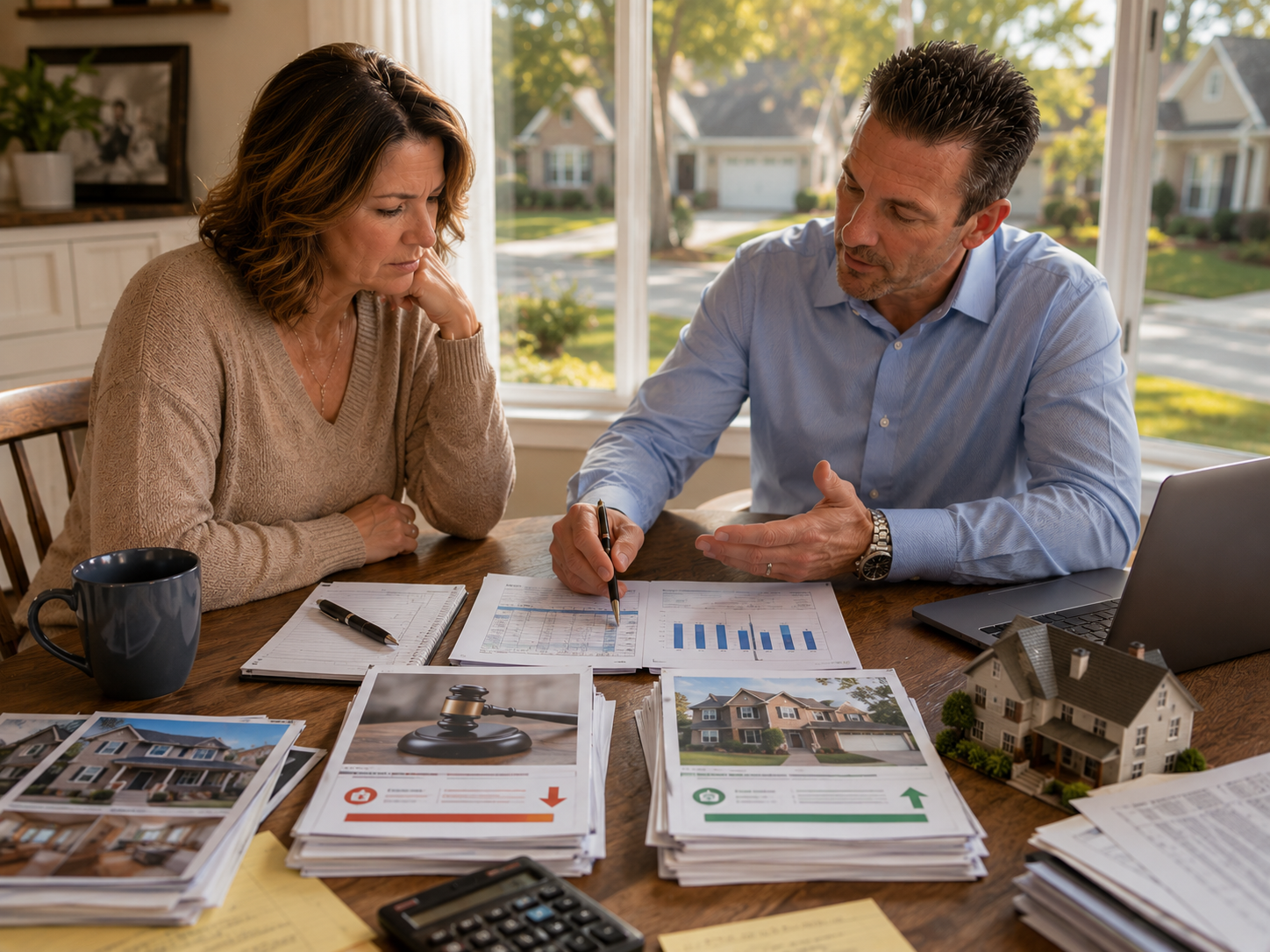
What I Know From the Investor Side That Most Kansas City Real Estate Agents Will Not Tell You
When a Kansas City homeowner's property goes to a trustee's sale auction, the investors bidding that day are not trying to help you get the best price. They are competing against each other to acquire your property at the number that leaves them enough margin to flip it profitably. In Jackson County and across the Kansas City metro, that margin target typically puts investor acquisition pricing at 25 to 35 percent below retail market value. They build in that spread because they absorb carrying costs, rehabilitation expenses, resale timeline risk, and their own profit requirement.
The math on a real transaction is worth understanding concretely. On a Kansas City home with a $275,000 retail value, an investor's acquisition target at trustee's sale might sit between $175,000 and $200,000, depending on condition. If the lender's minimum bid floors at $201,000 and that is where bidding stalls, the homeowner receives zero beyond their loan being satisfied. If the bid does not cover the full loan payoff plus accrued fees, some loan structures give the lender the legal basis to pursue a deficiency judgment for the remaining balance. The homeowner gets neither equity nor legal closure.
I have personally been on the investor side of this transaction more times than I can count. I have purchased properties at trustee's sale auctions, and I have purchased properties from homeowners in pre-foreclosure. Across those two paths on equivalent properties in the same Kansas City neighborhoods, the price difference between an auction acquisition and a pre-foreclosure retail sale has ranged from $30,000 to more than $60,000 on mid-range homes. That money does not disappear. It transfers directly from the homeowner's recoverable equity to the investor's margin because the homeowner did not know a better path existed, and no one told them in time.
Bringing an investor's underwriting perspective to a distressed seller consultation is what Jason DeLong at Heartland Homes KC does differently from a traditional listing-only agent. If you want an honest picture of what your property is worth to an investor at auction versus what it is worth to a motivated retail buyer with a fast-close requirement, that analysis is a core part of the initial strategy call at guaranteedsoldkc.com/schedule-call.
What to Look for in a Kansas City Real Estate Agent When You Are Facing Foreclosure
Choosing an agent when you are in default is not the same decision as choosing one for a standard retail listing. The skills required are different, the timeline management is different, the lender communication is different, and the pricing discipline required under real time pressure is categorically different from managing a six-week marketing campaign with room to adjust. Choosing the wrong agent in a distressed situation does not just cost you time. It can cost you equity you still had time to preserve.
The most important question to ask any agent you are considering is whether they have direct experience closing pre-foreclosure transactions in Kansas City within compressed timelines. Not experience with distressed properties generally. Specifically: how many pre-foreclosure listings have you closed where the seller had an active notice of default and a trustee's sale scheduled? What was the average days-on-market in those situations? How do you set a price that generates immediate buyer interest without leaving recoverable equity behind?
The second question is whether the agent has personal real estate investment experience. An agent who has underwritten and executed flip transactions independently understands exactly how investors analyze distressed acquisitions, which means they can identify when a cash offer is priced below competitive market value and protect you from signing a number that transfers your equity to someone else. The combination of active investor experience and licensed agent representation is not common in the Kansas City market, and it matters most precisely in the distressed sale scenario you are navigating.
Jason DeLong at Heartland Homes KC brings 17 years of Kansas City market experience, 150-plus personal investment transactions, an architecture and construction background that enables accurate rehabilitation cost assessment on the spot, and a full seller-option platform that matches the solution to the situation rather than defaulting to one path for every homeowner. The initial consultation is a no-obligation equity review that produces a clear picture of your timeline, your options, and what your net proceeds actually look like under each scenario. Schedule that conversation at guaranteedsoldkc.com/schedule-call before the options you have today narrow further.
FAQ BLOCK
Q: How do I stop foreclosure in Kansas City, MO, in 2026?
A: To stop foreclosure in Kansas City, MO, in 2026, you need to act before the scheduled trustee's sale date. Missouri's non-judicial foreclosure process can move from notice of default to completed sale in as little as 60 to 90 days, and Missouri does not provide a post-sale redemption period after a non-judicial sale closes. Your primary options are a pre-foreclosure listing with an experienced Kansas City real estate agent, a direct cash sale to a qualified local buyer, a formal loan modification through your servicer, or a deed in lieu of foreclosure as a last resort. Acting early preserves both options and equity. Every week of delay narrows the field.
Q: What is the Kansas City real estate market forecast 2026 for homeowners facing foreclosure?
A: The Kansas City real estate market forecast 2026 shows rising foreclosure filings across the metro as pandemic-era forbearance programs expire, which creates more distressed inventory and more investor competition at trustee's sale auctions. A potential Federal Reserve rate cut in the second half of 2026 is projected to spike retail buyer demand, which benefits homeowners who execute a pre-foreclosure sale before that demand surge arrives. Acting in the early-to-mid second half of 2026, rather than waiting on the process, positions distressed sellers to capture a more competitive buyer pool.
Q: How long does foreclosure take in Missouri in 2026?
A: Missouri is a non-judicial foreclosure state, meaning lenders do not require a court order to complete a trustee's sale. Once a notice of default is filed and the statutory 20-day minimum publication period for the trustee's sale notice is satisfied, the full process from first missed payment to completed sale can occur in as little as three to four months. Missouri provides no statutory right of redemption after a non-judicial sale closes. Pre-foreclosure action is the only path to equity recovery for Kansas City homeowners in default.
Q: Are cash home buyers in Kansas City a good option for distressed sellers in 2026?
A: Legitimate direct cash home buyers in Kansas City are a strong option for homeowners who prioritize speed and closing certainty over maximum sale price. The key distinction is between direct buyers who purchase the property themselves and close on the committed date versus wholesale assignment operations that market the contract to a third-party buyer over additional weeks the distressed seller may not have. Before engaging any cash buyer, verify they hold documented proof of funds, have a confirmed Kansas City closing track record, and are purchasing directly with no assignment clause in the contract.
Q: What happens to my equity if my Kansas City home goes to a trustee's sale?
A: If your Kansas City home completes a trustee's sale, any proceeds above the full lender payoff are theoretically returned to you. In practice, investor bidding at auction typically clusters near the lender's minimum bid rather than approaching retail market value, leaving most homeowners with minimal proceeds beyond debt satisfaction. If the final bid falls below the full loan payoff, including accrued fees and costs, some loan structures permit the lender to pursue a deficiency judgment for the remaining amount. A pre-foreclosure sale to a retail buyer almost always produces substantially better net proceeds for homeowners with positive equity, often by $30,000 to $60,000 or more on a mid-range Kansas City home.
You have options right now that you will not have in 30 days. That is not a sales line. That is the structure of Missouri foreclosure law, and it is the pattern I have watched play out across 17 years and more than 150 personal transactions in this market.
If you are in default or approaching default on a Kansas City property, schedule your no-obligation strategy call with Jason DeLong at Heartland Homes KC at guaranteedsoldkc.com/schedule-call today. In 20 minutes, you walk away with a real number on your equity, a clear picture of your timeline, and an honest breakdown of which options are worth taking before any of them close. No pressure. No obligation. Just a straight conversation with someone who has been on both sides of this market long enough to know what your options are actually worth.
The second half of 2026 moves fast. Whether you are facing foreclosure personally, helping a family member understand their choices, or building a distressed acquisition strategy as an investor in Kansas City neighborhoods, this is not a market where waiting for more clarity is free. The best realtor in Kansas City in a distressed situation is the one who gives you an honest picture up front, an investor lens, and agent experience in the same room, before the window closes on the outcome you still have time to reach.


