First-Time Home Buyer Kansas City 2026: Complete Guide
Pre-approval isn't optional in Kansas City right now. It's the entry ticket. But here's what almost nobody tells you: there are six decisions you need to make correctly before you even talk to a lender, and most first-time buyers skip straight to the Zillow app.
I've watched deals fall apart not because buyers couldn't afford the house, but because they didn't understand the sequence.
My name is Jason DeLong. I'm a Kansas City real estate agent, investor, and developer with Heartland Homes KC at eXp Realty. I have an architecture degree from Kansas State University, and I've personally built over 100 homes, flipped over 150 properties, and developed 25-plus subdivisions across this market. I've sat across the table from thousands of buyers. I know where first-timers get tripped up, and this guide is built to prevent that.
If you're ready to map out your personal game plan before you start touring homes, schedule a free buyer consultation here, and let's talk through your specific situation.
What's Actually Happening in the Kansas City Market Right Now
Before we talk steps, you need a realistic picture of the market you're walking into.
The Kansas City metro has stabilized in 2026. Median sales prices sit near $345,000, appreciation is running a more sustainable 3 to 4 percent annually compared to the spikes of 2023 and 2024, and inventory has climbed to roughly 2.8 months of supply. Homes are averaging around 43 days on market, which means the panic-buying era has cooled down and buyers have meaningful room to do proper due diligence. Emetropolitan
Here's what that means practically: you have more options than you did two years ago, but well-priced homes in the right neighborhoods still move fast. The market rewards buyers who are financially prepared and strategically positioned. It punishes buyers who are winging it.
I built my entire business model around helping people navigate this market with a real plan instead of a hope. Let's build yours.

Step 1: Know Your Three Numbers Before You Open Zillow
Most first-time buyers start with the house and work backward to the finances. That's exactly backward.
Before you look at a single listing, you need to know three numbers cold: your credit score, your monthly debt-to-income ratio, and the total cash you actually have available, not the total in your savings account, but what you could realistically put toward a home purchase.
For credit scores: conventional loan programs generally require a minimum of 620, but you'll access meaningfully better interest rates at 680 or higher. FHA loans allow scores as low as 580 with a 3.5 percent down payment, which is why they're popular with first-time buyers in competitive mid-range markets. Emetropolitan
For debt-to-income, most lenders want your total monthly obligations, including the new mortgage payment, to stay below 43 to 45 percent of your gross monthly income. A useful rule of thumb: your total housing payment should not exceed 28 percent of gross income. On an $85,000 household income in a market like Overland Park, that works out to roughly a $1,985 maximum monthly payment. Emetropolitan
For cash: remember that down payment and closing costs are separate. You need enough for both.
Here's a case study from my experience: I worked with a couple who came to me already pre-qualified and ready to look at homes. When we actually dug into their numbers, their debt-to-income ratio was sitting at 47 percent because of a car payment they hadn't factored in. They were a payoff away from qualifying cleanly, and they didn't know it. We pushed pause for 60 days, paid off the car, came back with a much stronger financial profile, and closed on a home they actually loved instead of settling for whatever they could barely qualify for. Knowing your numbers in advance changes the strategy entirely.
Step 2: Understand Your Down Payment Options, Including Programs Most Buyers Miss
The 20 percent down myth costs first-time buyers real money every year. They either wait too long to buy, trying to save an amount they don't actually need, or they drain their savings completely when better options existed.
Your realistic down payment options in 2026:
Conventional loans start at 3 percent down. You'll pay private mortgage insurance (PMI) until you reach 20 percent equity, but that's a manageable trade-off for getting into a home sooner.
FHA loans require 3.5 percent down with a score of 580 or higher. This is the most common path for first-time KC buyers in the $250,000 to $320,000 range.
VA loans require zero down for eligible veterans and active service members. Buyers near Whiteman AFB or Fort Leavenworth should always explore this option first, as it's hard to beat from a financial structure standpoint. Emetropolitan
USDA loans also require zero down and cover eligible areas on the outer edges of the metro. Parts of Platte County and other suburban fringe areas qualify. Ask your lender to check the USDA eligibility map for any property you're seriously considering.
On the Missouri side, the Missouri Housing Development Commission offers locked below-market interest rates through their First Place and Next Step programs, which can provide real long-term stability for your monthly payment. Both programs require working with an MHDC-certified lender, so ask any lender you're evaluating whether they're certified before you move forward. Danibeyer
If you want to go deeper on creative ways to cover your down payment, including strategies most buyers never hear about from their lender, read our full breakdown here: Creative Down Payment Solutions for KC Buyers.
Also, don't forget closing costs. Budget 2 to 3 percent of the loan amount on top of your down payment. On a $280,000 home that's roughly $5,600 to $8,400 in addition to whatever you put down. Some sellers will contribute a credit at closing, especially on homes that have sat longer, but don't build your strategy around assuming that.
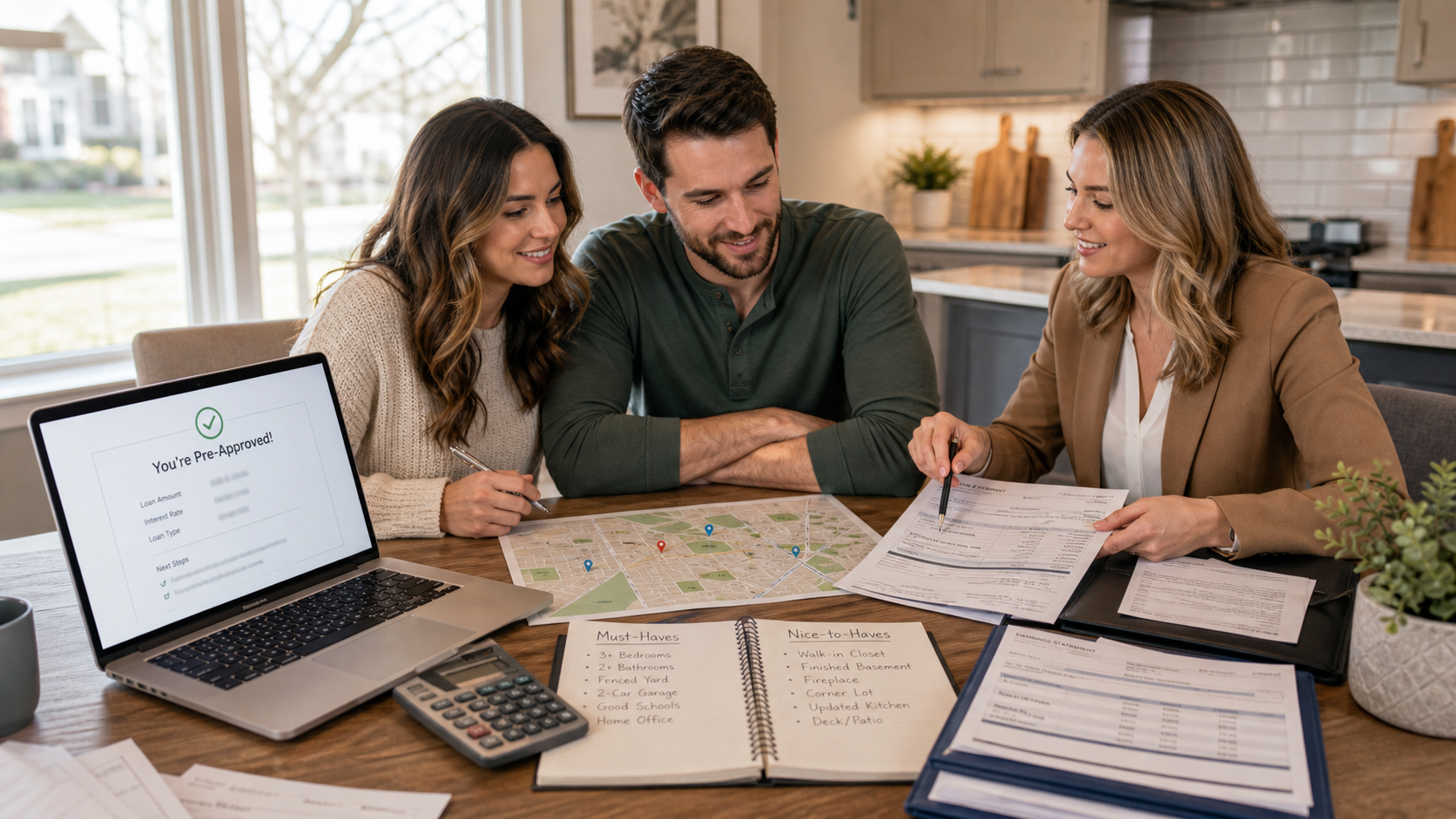
Step 3: Get Pre-Approved (Not Pre-Qualified, Pre-Approved)
This distinction matters more in the 2026 Kansas City market than almost any other single factor.
Pre-qualification is a quick ballpark based on what you tell a lender with no verification. It's nearly worthless in a competitive situation.
Pre-approval means the lender has pulled your credit, reviewed your income documentation, verified your assets, and issued a conditional commitment. It's the difference between being a serious buyer and being a browser in the eyes of every listing agent in the market.
In competitive Kansas City neighborhoods like Overland Park, Lee's Summit, and Brookside, listings routinely receive multiple offers within days of going live. If you're competing against a buyer with a strong pre-approval and you show up with a pre-qualification, you lose. Full stop. Mojokc
What you need to get pre-approved: two years of tax returns and W-2s, recent pay stubs, two to three months of bank statements, a government-issued ID, and employer contact information.
Use a local lender if at all possible. Local lenders know the Kansas City market, have existing relationships with listing agents, and can move faster when timelines compress. That last point matters more than most first-time buyers realize.
Step 4: Define Your Non-Negotiables Before You Fall in Love With a House
The most expensive mistake I see first-time buyers make is letting emotion drive decisions that should be strategic.
Before you tour a single home, write down your actual non-negotiables: minimum bedroom count, school district requirements if you have kids or plan to, commute tolerance, garage needs, and any accessibility requirements. These are dealbreakers.
Then write down your want list separately: updated kitchen, open floor plan, finished basement, larger yard. These are nice-to-haves.
In the $250,000 to $350,000 range in Kansas City, you may not find a home that checks every box. Buyers who know the difference between their needs and their wants make faster decisions and write better offers. Buyers who treat everything as a dealbreaker either lose deals to better-prepared competition or spend six months touring homes and getting nowhere.
Also think honestly about condition tolerance. Are you open to something cosmetically rough if the price reflects it? Or do you want move-in ready? Your answer determines which parts of the market you're shopping in and how you'll compete.

Step 5: Choose the Right Kansas City Neighborhoods for Your Goals
Kansas City is a metro with dramatic neighborhood variation in price, character, school quality, and long-term appreciation trajectory. Choosing the right area is one of the highest-leverage decisions in this entire process.
Here's my honest assessment of the major first-time buyer markets:
The Northland, covering North Kansas City, Liberty, Kearney, and Gladstone, delivers the best value per square foot in the metro for buyers who want newer construction and strong schools. Gladstone and Liberty in particular consistently offer quality homes under $300,000 with top-tier school districts. If maximizing square footage and land while staying in a suburban setting is your priority, this is where I'd start. Emetropolitan
Johnson County, including Overland Park and Lenexa, commands higher prices but delivers some of the strongest long-term resale values in the metro. Schools consistently rank at the top across the region. If school quality is your primary driver and your budget supports it, Johnson County earns its premium.
Lee's Summit and Blue Springs on the south side of Jackson County offer a strong mid-range option. Lee's Summit has a legitimate downtown, strong community identity, and consistent demand. Homes hold their value well and the area attracts buyers who stay for years, which keeps the market relatively stable.
Midtown and Waldo inside Kansas City proper give you walkability, architectural character, and proximity to everything the city has to offer. Waldo and West Waldo remain the gold standard for starter homes in this area, with 1940s bungalows averaging $330,000 to $360,000. These neighborhoods reward buyers who research block by block rather than just ZIP code. Emetropolitan
Independence and Raytown offer the most affordable entry points in the metro if budget maximization is your top priority. Resale timelines tend to be longer, but for buyers planning to stay five to seven-plus years, the equity math can work very much in your favor.
Browse current listings across all of these markets and see what's available right now here: Featured Listings Across Kansas City Neighborhoods. And if you want to know what your current home or a potential purchase is worth before making a move, run a quick estimate here: Home Value Tool.
Step 6: Work With a Local Kansas City Real Estate Agent Who Actually Knows the Market
Following the 2024 NAR settlement, the buyer-agent relationship changed. You now sign a Buyer-Broker Agreement upfront, and while most sellers in Kansas City still offer a concession to cover buyer agent commissions, it's not automatic and you should ask your agent directly how their compensation works before you commit. Emetropolitan
What hasn't changed is how much the quality of your representation matters.
Your agent should know the neighborhoods you're targeting well enough to tell you when a price is too high, when a street has issues that don't show up on Zillow, and when a home that photographs beautifully is hiding deferred maintenance. They should know how to structure a competitive offer without getting you into a deal you'll regret. And they should be reachable when something moves fast, because when something good becomes available in the sub-$350,000 range in this market, it moves fast.
I built Heartland Homes KC around a seller-first philosophy, but the principle is the same on the buyer side: the goal is always the right outcome for the client, not the fastest close. My architecture background means I can walk a property with you and flag structural and mechanical issues that most agents wouldn't catch. That's not a small thing when you're making the largest purchase of your life.
Curious what our process looks like? Our 100-Point Marketing Plan shows the depth of strategy we bring to every transaction, even if you're buying, not selling.

Step 7: Tour Homes Like a Builder, Not a Decorator
Here's something I've learned from having built over 100 homes personally: the things that make a house look good are rarely the things that make it expensive to own.
Fresh paint, new countertops, and staged furniture create emotional appeal. The things you actually need to evaluate are the roof age, HVAC system condition and age, water heater age, foundation, and electrical panel. These are the systems that cost the most to replace and that will show up in your inspection report.
In Kansas City specifically, you need to watch for three regional red flags: foundation cracks in the clay soil (look for stair-step patterns in brick), sump pump presence and condition in basements especially heading into spring storm season, and roof age since Midwest hail can drive a 10-plus-year-old roof into a higher insurance premium category. Emetropolitan
Your agent should be pulling comparable sales data before you set foot in any home. Don't let yourself fall emotionally attached to a property before you know what it's actually worth relative to what else has sold in that neighborhood in the last 90 days.
Step 8: Structure an Offer That Actually Wins
Speed and structure both matter in this market, and they have to work together.
In active price ranges, hesitating 24 to 48 hours to decide often means losing the home. If it's well-priced and well-located, other prepared buyers are seeing exactly what you're seeing.
A clean offer often beats a high offer in Kansas City. Earnest money of 1 to 2 percent of the purchase price signals seriousness. Your agent should also discuss appraisal gap coverage with you for higher-competition ZIP codes where bidding over list price is common. Emetropolitan
Your pre-approval letter from a credible local lender should accompany every offer. Before submitting, your agent should call the listing agent and find out what the seller's priorities actually are. Closing timeline, flexibility on possession date, certainty of close, these factors can move a deal as much as price in the right situation.

Step 9: Navigate the Inspection and Appraisal Without Losing the Deal
Once you're under contract, two things stand between you and closing: the home inspection and the lender's appraisal.
The inspection is for you. In Kansas City, the standard "Big Three" inspections are a full home inspection covering structural and mechanical systems, radon testing (which is extremely common in the region at roughly $150 added), and a sewer scope especially for older homes in neighborhoods like Waldo or Midtown at around $150 to $200. Walk through with the inspector if you can. Ask every question that occurs to you. This is your one clean look at what you're actually buying before you own it. Emetropolitan
The appraisal is for the lender. They need confirmation that the home is worth what you're paying before they'll fund the loan. If the appraisal comes in below your purchase price, you have three options: negotiate the price down with the seller, make up the gap in cash, or walk away if your contract has an appraisal contingency. Your agent's job is to advise you clearly on which move makes sense given the market and your specific situation.
Step 10: Close Smart and Get the Keys
If you've executed the steps above correctly, closing should be the least stressful part of this entire process.
Do a final walkthrough 24 hours before closing to confirm the property is in the agreed-upon condition. Bring your government-issued ID. Expect a significant volume of paperwork, most of which your lender and title company will walk you through.
One critical warning: verify wire transfer instructions by phone directly with the title company before you send anything. Wire fraud targeting real estate transactions is real, it's common, and it's how buyers lose tens of thousands of dollars right before the finish line. Call and confirm verbally. Every time.
Once you sign, the lender funds the loan, and the deal records, you own the home. That's it.
Case Study: What a First-Time Buyer Process Actually Looked Like in Kansas City
I had a young couple come to me a few years back. Both working, solid income, eager to buy. They'd been browsing Zillow for months and thought they were ready. When we sat down and went through their actual finances, their credit was fine but they had a significant amount in a savings account they were counting as their down payment, without accounting for the closing costs or the moving expenses or the first few months of homeownership costs that always come up.
They were looking at $285,000 homes but realistically needed to be targeting the $255,000 to $265,000 range to close comfortably. We recalibrated. We found them a home in the Northland, solid neighborhood, good school district, needed some cosmetic updates but was structurally clean. I walked through it with them and identified what was cosmetic versus what was real. Because of my construction background I could tell them to the dollar roughly what the cosmetic work would cost.
They bought it at $258,000. Updated the kitchen and bathrooms over the next 18 months for about $22,000. The home is now worth over $330,000. Not every deal works out that clean, but that's what happens when you go into the process with a real plan instead of just emotion and a Zillow app.
FAQ: First-Time Home Buyer Kansas City 2026
What credit score do I need to buy a home in Kansas City in 2026?
Most conventional programs require a minimum of 620. You'll access better rates at 680 or above. FHA programs allow as low as 580 with a 3.5 percent down payment. If your score needs work, talk to a local lender before you assume you're not ready. A 60 to 90-day credit improvement plan changes the math more than most people expect.
How much do I need for a down payment in Kansas City?
Conventional loans start at 3 percent down. FHA requires 3.5 percent. VA and USDA programs offer zero down for eligible buyers. Missouri's MHDC programs offer below-market rates and assistance for income-eligible buyers. Always budget separately for closing costs at 2 to 3 percent of the loan amount on top of your down payment.
What are the best neighborhoods in Kansas City for first-time buyers?
It depends entirely on your priorities. The Northland delivers the most value per square foot. Johnson County delivers the strongest schools. Lee's Summit and Blue Springs hit the mid-range sweet spot. Waldo and Midtown give you urban character. Independence and Raytown offer maximum affordability. The right answer depends on your commute, school situation, and five to seven-year plan.
How competitive is the Kansas City market for first-time buyers right now?
More balanced than 2023 and 2024, but not slow. Inventory has improved and homes are averaging around 43 days on market. However, well-priced homes in strong neighborhoods in the $275,000 to $350,000 range still generate real competition. Coming in prepared with pre-approval and a clear offer strategy is still the difference between winning and losing deals.
Do I need a real estate agent as a first-time buyer in Kansas City?
You're not legally required to use one, but the complexity of the KC metro, multiple counties, different school district boundaries, varying property tax rates across the state line, different HOA disclosure norms, means the buyer who goes in without local representation is at a structural disadvantage compared to the buyer who doesn't. Buyer representation is typically covered by the seller at closing.
Is Kansas City a good market to buy your first home in 2026?
Yes, and compared to most major metros, it's not particularly close. Prices remain accessible, job growth has been diversified across healthcare, logistics, and technology, and the neighborhood variety means you can find something that actually fits your life and your budget. The buyers who win here in 2026 are the ones who show up prepared.
Ready to Buy Your First Home in Kansas City?
The market rewards preparation. The buyers who lose deals are almost always the ones who started the process without a clear financial picture, a realistic neighborhood target, and a competitive offer strategy.
If you're serious about buying in 2026, let's talk before you make a single move. I'll walk you through where you actually stand financially, which neighborhoods fit your goals, and exactly what it takes to compete and win in your target price range.
Schedule your free buyer consultation here. The Heartland Homes KC team is ready to help you find the right home, in the right neighborhood, at the right price.
And if you want to get ahead on understanding your financial position right now, check your home value here or see what a cash offer looks like on your current home here to understand all your options before you make a move.


