
1031 Exchange Rules for Kansas City Investors (2026 Guide)
1031 Exchange Rules Explained for Kansas City Investors in 2026
Three and a half percent down on a Kansas City duplex, a tenant covering most of the mortgage. That is still the single best first move for a young buyer in this market. I have watched people build real wealth starting from exactly that.
But getting in the game is the easy part. The move that actually builds generational money happens later, when that first duplex has appreciated and you want to trade up into something bigger. Do it wrong and the IRS takes a third of your gain. Do it right, using the 1031 exchange rules, and you roll every dollar forward and keep compounding.
I have built more than 100 homes, flipped over 150, and developed subdivisions all across the metro. I have also sat across the closing table from plenty of investors who left tens of thousands of dollars behind because nobody explained the rules to them. This is that explanation, updated for 2026, with the Kansas City specifics that generic tax blogs will never mention. If you want to map your own situation, you can schedule a call anytime.
Quick disclaimer before we dig in. I sell, build, and invest in real estate. I am a Kansas City real estate agent, not your CPA or attorney. Use this to get smart, then confirm the details with a qualified intermediary and your tax pro before you pull the trigger.
What a 1031 Exchange Actually Does (And What It Does Not)

A 1031 exchange lets you sell an investment property and buy another one while you defer the capital gains tax. That word matters. You defer the tax, you do not erase it. You push the bill down the road, which frees up every dollar of your gain to go back to work in the next deal.
When people talk about how a 1031 helps you defer capital gains on real estate, here is what is actually on the line:
Federal long-term capital gains tax, at 0, 15, or 20 percent depending on your income.
The 3.8 percent net investment income tax that hits higher earners.
Depreciation recapture, taxed as high as 25 percent.
That last one is the sleeper. If you have owned a rental for years and written off depreciation the whole time, recapture alone can be a brutal number at sale. A 1031 defers all three at once.
One more thing for 2026. The strategy is fully alive. The One Big Beautiful Bill Act left 1031 exchanges untouched, and a proposed cap on annual deferral did not pass. Real estate held for investment still qualifies, exactly as it has since 2018. Headlines about repeal come and go. Nothing has changed the rules.
The Core 1031 Exchange Rules That Actually Matter
There are a lot of rules. Most articles bury you in all of them. Here are the ones that decide whether your exchange survives.
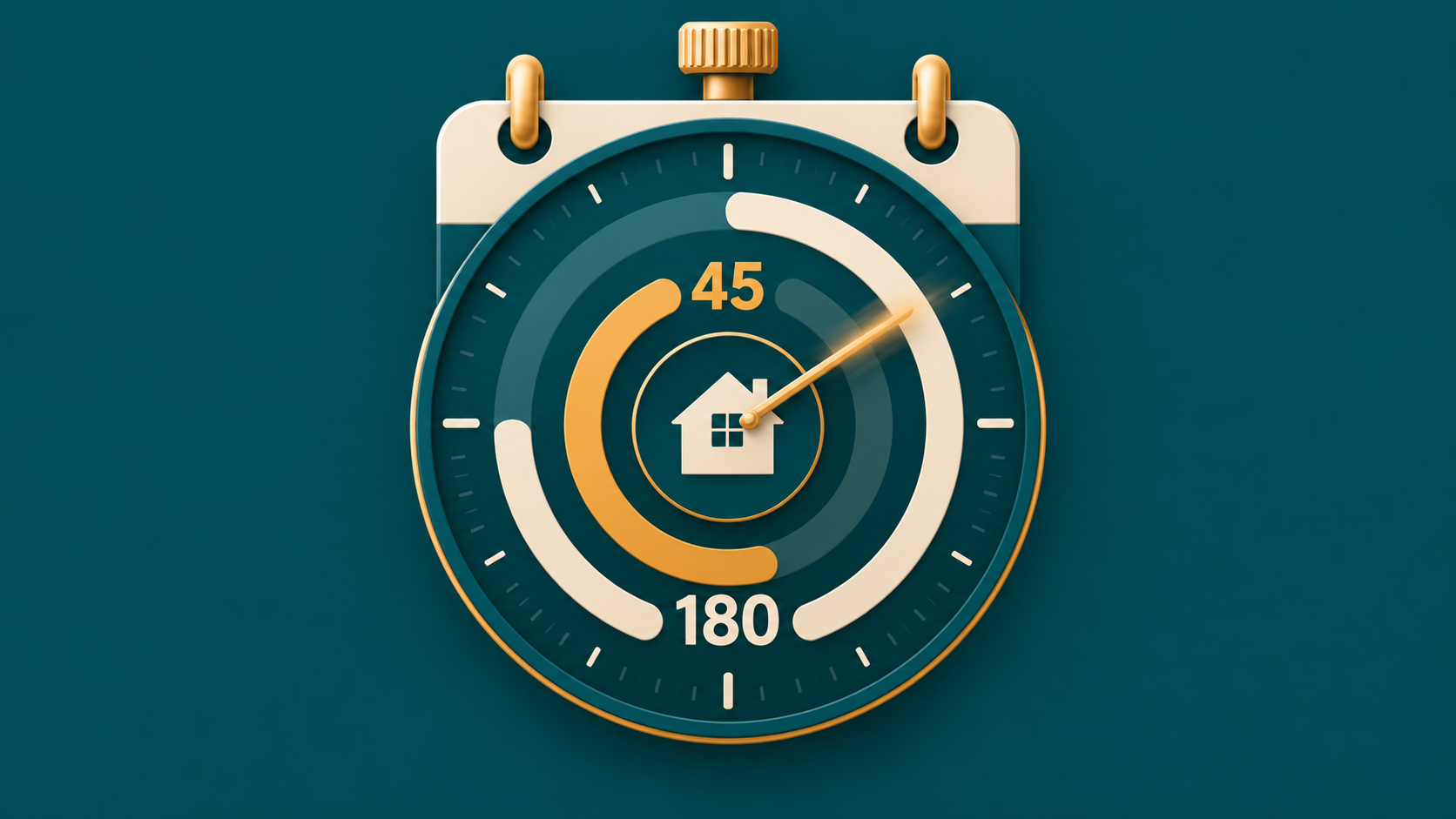
The 45-Day and 180-Day Clock
This is the rule that kills most exchanges, so learn the 1031 exchange timeline cold. The 45 days come first.
From the day you close on the property you are selling, you have 45 calendar days to identify your replacement property in writing.
From that same closing day, you have 180 calendar days to close on the replacement.
Both clocks start together and run at the same time. The 45 days sit inside the 180.
There are no weekend or holiday extensions. Miss it by one day and the whole exchange collapses.
One pro tip that catches people. The 180 days can be cut short by your tax filing deadline. If you sell late in the year, file an extension so you keep the full window.
Like-Kind Is Broader Than You Think
The like-kind exchange rules confuse people because the name sounds strict. It is not. Like-kind does not mean identical. Any United States real estate held for investment or business swaps for any other United States real estate held for investment or business.
A rental duplex for raw land. Like-kind.
A single-family rental for a small apartment building. Like-kind.
A retail strip for a warehouse. Like-kind.
What does not qualify is just as important. Your primary home does not qualify. A vacation house you actually use does not qualify. And property you are flipping does not qualify, which trips up a lot of Kansas City investors. More on that in a minute. Also note that since 2018, only real property counts. Equipment and vehicles were removed years ago.
Identify the Right Way
You have to name your targets, and there are two clean ways to do it.
The three-property rule. Name up to three replacement properties, at any value.
The 200 percent rule. Name more than three, as long as their combined value stays under 200 percent of what you sold.
Put it in writing and get it to your intermediary before day 45. A verbal plan does not count.
You Cannot Touch the Money

This is the most common self-inflicted mistake I see. You are not allowed to take possession of the sale proceeds, not even for a single day.
A qualified intermediary holds the funds between your sale and your purchase. If that money lands in your bank account, the exchange is dead and the gain is taxable. Line up your intermediary before you close, not after.
Equal or Greater, or You Owe on the Difference
To defer 100 percent of the tax, three things have to be true. Your replacement property has to be equal or greater in value. You have to reinvest all of your equity. And you have to replace the debt you paid off, or add cash to cover it.
Anything you pocket along the way, whether it is cash or debt relief, is called boot. Boot is taxable. If full deferral is the goal, trade up, not down.
Same Taxpayer, and the Related-Party Trap
Whoever sold has to be whoever buys. Same name, same tax ID. If you sold as an LLC, that same LLC buys the replacement.
And be careful buying from or selling to a related party, meaning family or entities you control. That triggers a two-year holding rule. Break it and the deferral unwinds.
The Flip Trap: Why Your Best Deals Might Not Qualify

Here is a truth that stings, and I say it as someone who flips a lot of houses. Flips do not qualify for a 1031.
The IRS looks at intent. Property held primarily for resale is inventory, the same way a builder's spec homes are inventory. It is not investment property. So the houses I flip and the spec homes I build to sell do not get 1031 treatment, and neither do yours. That is just the cost of doing business as a dealer.
What does qualify is the buy-and-hold side of your business. The rentals. The Airbnb you operate. The land you sit on for appreciation. Investment intent, held over time.
The practical line. If you bought it to sell fast, it is a flip. If you bought it to hold and it happened to appreciate, it is an investment. There is no magic number of days, but a year plus of documented rental use is a far safer position than a four-month turn.
The Kansas City Twist: Two States, Two Very Different Tax Bills

This is what generic 1031 articles will never tell you, and it is the whole reason a local guide matters. Kansas City sits on a state line, and in 2026 those two states could not treat your gain more differently.
On the Missouri side, a 2025 state law changed the game. Missouri became the first state in the country to fully exempt individual capital gains from state income tax. If your rental is in Jackson, Clay, or Platte County, and you hold it personally or in a pass-through LLC, your Missouri state tax on the gain is effectively zero in 2026, exchange or no exchange.
On the Kansas side, that did not happen. Kansas still taxes capital gains as ordinary income, at a top rate of 5.58 percent in 2026. So a sale in Johnson County, or anywhere on the Kansas side, still carries a real state tax bill.
Here is what that does to your strategy.
On the Missouri side, the state benefit of a 1031 is basically gone. Your entire reason to exchange is the federal deferral, the 0 to 20 percent capital gains, the 3.8 percent net investment income tax, and that 25 percent recapture. Often still worth it, especially with recapture in play, but the math has shifted.
On the Kansas side, a 1031 still shields both the federal gain and that 5.58 percent Kansas hit. The case to exchange is simply stronger.
Translation. Which side of State Line Road your property sits on now changes whether an exchange is even worth the effort. One quick note, the Missouri exemption applies to individuals and pass-through entities, not C-corporations yet, so confirm how you hold title with your CPA.
Building Your Replacement Property Instead of Buying It

Most people think a 1031 means buying an existing property off the market. It does not have to.
A construction or improvement exchange lets you use your exchange funds to build or improve the replacement property. An exchange accommodation titleholder holds title while the work gets done, and the improvements have to be in place inside the 180-day window.
This is the part that lines up with my background. I came out of the architecture program at Kansas State and have spent 20 years building homes and developing land in this metro. For an investor who wants to roll gains into new construction, a build-to-suit rental or a small new-construction duplex, this is one of the most powerful and least used tools in the code.
The catch is the timeline. 180 days does not build much from bare dirt. This works best when you are finishing, improving, or building something that can realistically be completed and paid for inside the window. Plan it with a builder and an intermediary who have actually done one before.
How This Ties Back to That 3.5 Percent Down Duplex

Let me circle back to the young buyer from the top, because there is a catch. You cannot 1031 your way into that first duplex. An exchange needs a property you already own as an investment and are selling. And your primary residence is not 1031 property at all. It falls under a different rule, Section 121, which can exclude up to $250,000 of gain for a single filer or $500,000 for a married couple on a home you actually lived in.
Now here is the elegant part of a house hack. If you live in one side of the duplex and rent the other, the IRS treats the two halves differently. The half you live in can use that primary-residence exclusion. The rented half can qualify for a 1031 when you sell and trade up. Two tax breaks, one building.
So the full arc looks like this.
Start with 3.5 percent down on a duplex. Live in one side, rent the other.
Let it appreciate while the tenant pays the note.
When you are ready, use the Section 121 exclusion on your half and a 1031 on the rental half to trade into a fourplex or a small apartment.
Keep exchanging up over the years, deferring the whole way.
The final move most people never hear about. Hold until you die. Your heirs inherit at a stepped-up basis, and the entire deferred gain gets wiped out. Investors call it swap till you drop. It is about as close to a legal cheat code as real estate offers.
Mistakes I See Kansas City Investors Make
Missing the 45-day identification window because they went shopping after the sale instead of before it.
Taking the sale proceeds into their own account and killing the exchange on the spot.
Trading down and getting surprised by a boot tax bill.
Trying to 1031 a flip that never qualified in the first place.
Assuming the Missouri exemption means they can skip the planning. It changes the state math. It does nothing about the federal exposure.
Waiting until the closing table to find a qualified intermediary.
Your Next Move
If you are sitting on a Kansas City rental with a big gain, the worst thing you can do is sell first and figure out the tax later. The exchange has to be set up before you close. Once the money moves, your options are gone.
A few smart first steps.
Know your number. Get a real read on what your current property is worth before you plan anything. Start with a quick home value estimate, then get a proper valuation.
Line up the sale to hit the windows cleanly. If you need speed and certainty on the sell side, a straight cash sale makes the 45 and 180-day math much easier. We run cash home buyer options in Kansas City through our cash offer program.
Sell for the most, so you have the most to roll forward. When we list, we run the Heartland Homes KC 100-point marketing plan to push the price as high as the market allows. More net means more compounding inside your exchange.
Know where to redeploy. Not every one of the Kansas City neighborhoods is appreciating the same way, and picking the right one matters when you only have 45 days to identify. Browse featured listings across Kansas City neighborhoods to see what is actually moving and where the best neighborhoods in Kansas City are trending.
Then let's map it. The 1031 exchange rules are not complicated once someone walks you through them with your actual deal on the table. Schedule a call and we will build the plan around your property, your timeline, and which side of the state line you are on.
Frequently Asked Questions
How long do I have to complete a 1031 exchange in 2026?
You have 45 days from your sale closing to identify replacement property in writing, and 180 days from that same closing to finish the purchase. Both clocks run at the same time. The 180 days can be shortened by your tax filing deadline, so file an extension if you sell late in the year.
Can I do a 1031 exchange on a house I am flipping in Kansas City?
No. Flips are treated as inventory held for resale, not investment property, so they do not qualify. Buy-and-hold rentals, Airbnbs, and land held for appreciation are the ones that qualify.
Does the Missouri capital gains exemption replace a 1031 exchange?
Not exactly. Missouri now exempts individual capital gains from state income tax, so the state benefit of an exchange on the Missouri side is largely gone. But you still owe federal capital gains tax and depreciation recapture, and a 1031 is what defers those.
What happens if I miss the 45-day deadline?
The exchange fails and your full capital gain becomes taxable that year. There are no routine extensions, although federally declared disaster areas can trigger automatic relief in some cases.
Do I need a qualified intermediary for a 1031 exchange?
Yes. You cannot take possession of the sale proceeds. A qualified intermediary has to hold the funds between the sale and the purchase, and they need to be in place before you close.


